
Want your AI tools to create better content?
Then you need to feed it the right starter info, says Erika Heald.
When an AI has the proper “content governance” in place, it can generate on-brand content, freeing up a marketer’s time for the work that requires your human touch.
Discover how Erika uses “content governance” from this clip from B2B Forum 2025, or read the transcript below.
B2B Forum returns to Boston this November 2026, with even more insights and ideas marketing leaders like you can use to become more efficient and valuable. Tickets are on sale now—and they’re the lowest price they’ll be as we lead up to the event. Find additional information and registration options here.
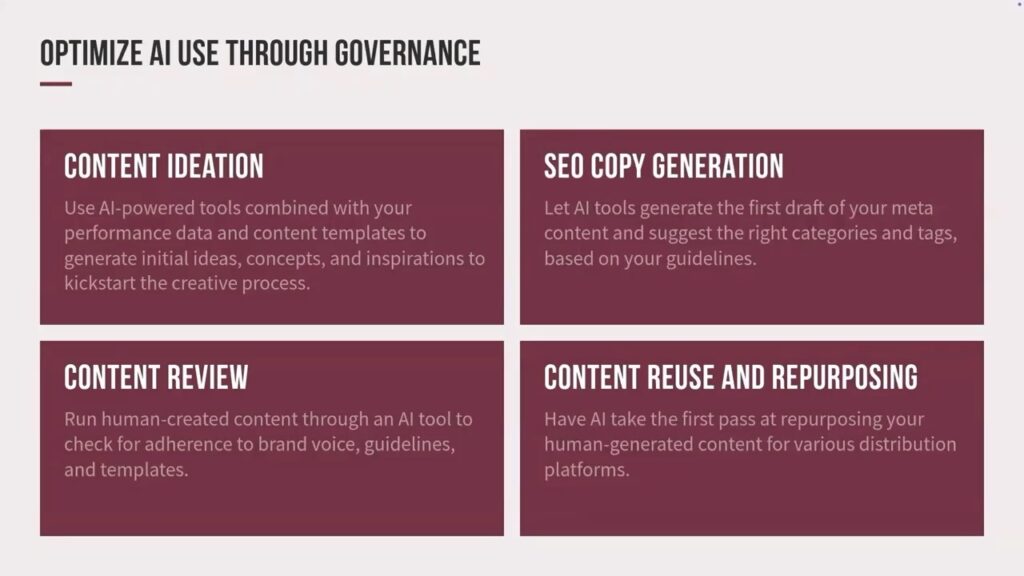
How do I like to use AI and optimize it with governance?
First of all, I like to use it in order to do that ideation: combining my data, with my taxonomy, with my content strategy, with the content templates for whatever it is that I’m trying to create.
For example, I had a client. And every time we wanted to do an email to the email list, there were five leadership people—who did not have “marketing” in their job titles or in their responsibilities—who wanted to edit things and add things and ruin every email.
And I’m not somebody who likes writing emails in the first place.
But I really don’t like to write email by consensus.
What we ended up doing is, we agreed upon a recipe.
Because I’m a baker, I’m like, “let’s just do a recipe!”
That sounded very friendly and benign, and I knew I could get them to agree to it.
I’m like, “let’s just create a recipe for, ‘what does an email campaign look like for nurturing people along this path?’”
Got them to agree.
Well, the first one is more of the introductory, “Hey, you probably have a problem…”
And I walked them through it, got them to agree to the template.
And then we actually took some of their data, we took those templates, we took their brand voice, their style guide, all of those things…
And then I had AI write the drafts of those emails.
Do you know how much easier and less painful it was for all of us to do that?
Because yes, there was still feedback.
But we were able to say, “hey, we all agreed upon what this email’s job was. We all agreed this is how long we wanted it to be.”
We had the data for what’s worked before, so it took out a lot of that non-productive friction.
Some friction is good. But if your writers want to jump out the window every time they have to go to a meeting to talk about an email campaign, that is not good.
So to me, that’s how [AI] can really help with the ideation.
The other thing that AI-plus-governance does really, really well is SEO copy generation: creating the first drafts of your meta description or your titles.
Especially if you’re like, “I have thousands of pages on this website. We have had this blog for 10 years. We probably do have a title somewhere that is similar to this, I don’t know!”
You can have the AI look, because you have that Google analytics data that has all of your pages, all of the title tags for those pages.
You can ask the AI to create that differentiated meta description and title so that way it still serves the purpose, it doesn’t create a duplicate problem, et cetera.
And who here is like, “Oh, but Erica, I really wish I could spend more time writing SEO copy.” Yeah, no way.
Of course: content review, but also content use and repurposing.
Because if you are in the situation where there’s a social media platform that you have to be on… that you no longer like being on… wouldn’t it be great if the AI could just write that copy for you and you can lightly edit it and just hand it off and go, “here you go,” and not care about it and not belabor it?
So all of these things are, to me, some of the really easy, low-hanging fruit use cases that having the content governance in place really can enable.
All right, so you’ve created your “content governance toolbox.” You’ve figured out all of the different templates that you want. You have it all there.
That’s when you can start looking at those workflows, figuring out where you can plug in AI to do the work that you don’t want to do so you can do more of the work that needs that human touch, the work that you like to do.
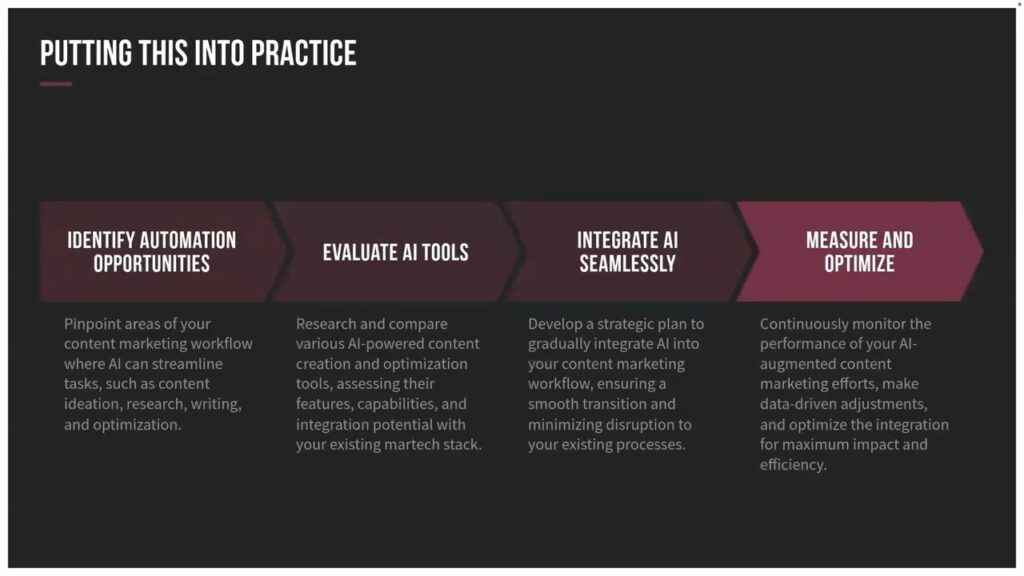
Then you go through the evaluation process because you’ve seen, I’m sure, Scott Brinker’s chart now.
(You can’t even read anything on it for all of the AI tools and for all of the AI marketing tools. And for each use case in the “marketing AI use case” categories. There’s so much out there!)
But because you have all of this stuff in place and you understand what you are trying to accomplish with your content, you’ll be able to figure out what kinds of evaluation criteria you have and create that checklist.
And then have the AI go out there, evaluate the tools, give you the shortlist, and then you just do a couple of demos.
Because again, you already have done the work of putting all that governance in place.
Then the integration will be easy, because you’ve already figured out the workflows, you know what you’re trying to do, you know all of your outputs for all of those channels for distribution. So that just means you just create, you run things, and then you can measure and optimize.
It’s kind of amazing and awesome.
And most of us are nowhere near being at the end of that.
And I know that because three weeks ago, at Content Marketing World, I launched—with Pamela Muldoon and Carmen Hill—we launched a Content Marketing Maturity Assessment.
It’s a free assessment.
And it’s been so much fun seeing where folks are with their content programs. So if you’re interested in doing that, come see me and get one of those cards because there’s so much you can do with your AI tools.
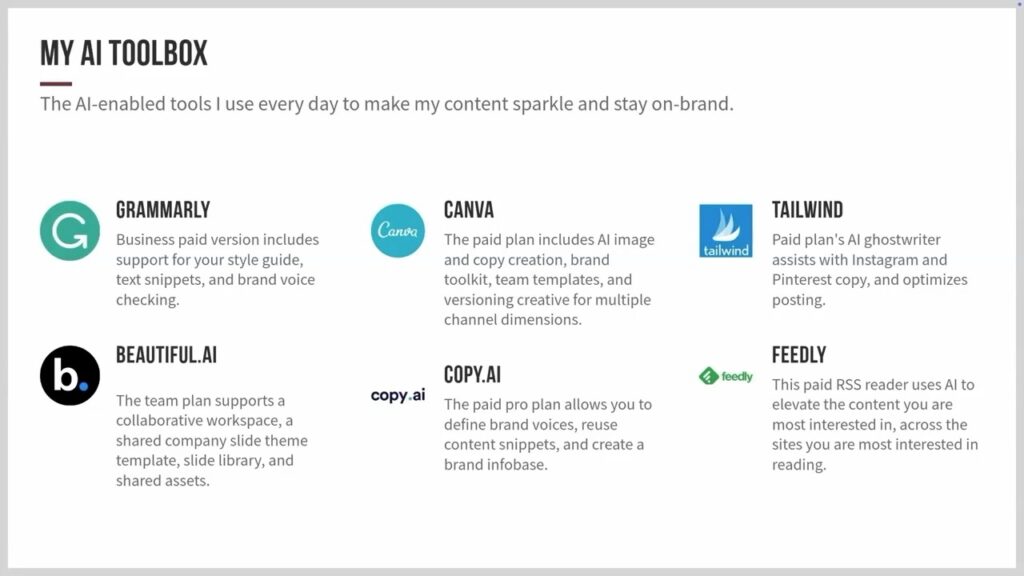
Now… because everyone always asks… these are the tools that I use most frequently on a daily basis.
Pretty much all of the slides here were made with beautiful AI. Not the content on them… except for the one slide that I showed you where it got things very, very wrong!…
But these are the tools that I use all the time in order to be able to just get things done more quickly.
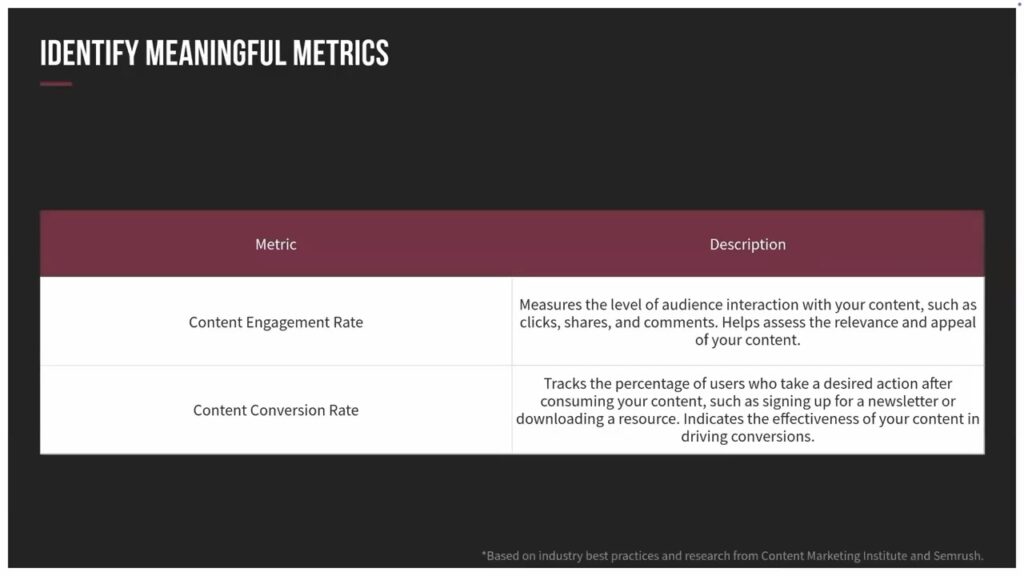
When it comes to showing the ROI of slowing down, taking the time to put content governance in place, to me, the two biggest ones that you’re going to be able to measure are: your content engagement rate, and your content conversion rate.
And if you can’t measure these, then we really need to take a step back and figure out what is going on in your organization. Why are you creating content?
Because these are things that, if you can’t measure them, this is how you get replaced with AI.
Published January 8, 2026
B2B Forum is packed with marketing insights, strategies, and tactics taken from the real world experience of over fifty industry experts, packaged into context you can actually put to use.
Join us in Boston for B2B Forum on November 2-4, 2026. Early buyers get B2B Forum tickets at their lowest rate, and discounted hotel rooms are available while they last.