Is it a crime in B2B to rhyme?
Nancy Harhut, behavioral-science marketer and co-founder at HBT Marketing, shared ways to make your marketing messages get attention and stick with your audience at B2B Forum 2025.
Because a message that gets attention… gets retention.
Get Nancy’s neurological insights to better messaging in this clip from B2B Forum, or read the transcript below.
B2B Forum is filled with ideas marketers like you can apply to improve business, and it’s returning to Boston this November 2-4. As of right now, the program is still in the works, which means…
Ticket prices are criminally low!
Don’t let your industry peers have all the fun (while you get none). Get your B2B Forum ticket now to become a smarter, more inspired marketer. Click here for details.
The “rhyme is reason” bias…
And this is really interesting:
Behavioral scientists have found that, broadly speaking, there are two different ways you can say something.
You can convey the same information in a way that rhymes, or in a way that doesn’t rhyme.
Just generally speaking, those are two broad categories. Same information, it either rhymes or it doesn’t.
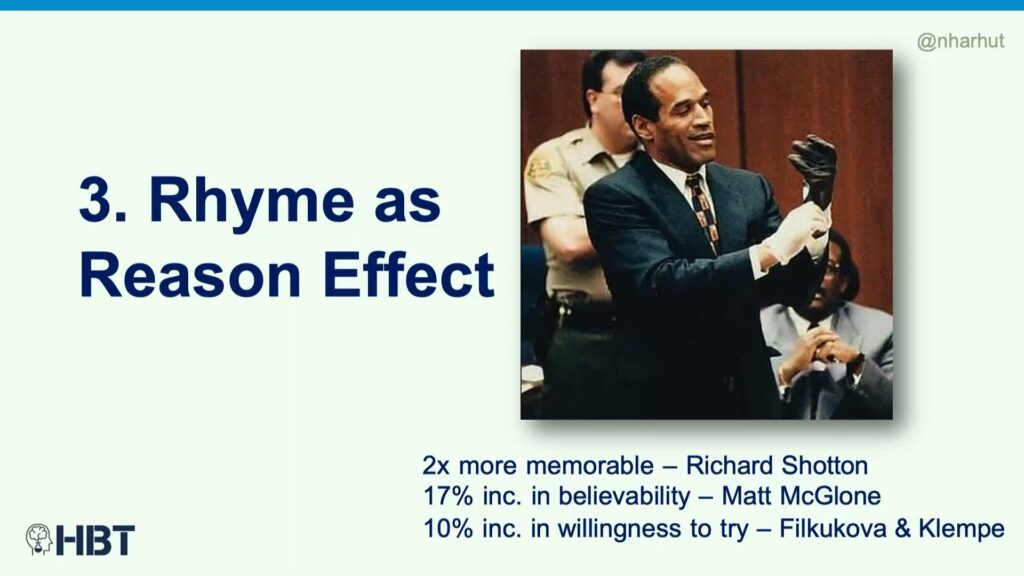
So if anybody remembers the OJ Simpson trial… some of you must, right? Okay. His attorney Johnny Cochran said, “if the glove doesn’t fit…” There we go!
Oh my gosh! It’s like a call and response. I love it! Yes: “If the glove doesn’t fit, you must acquit.”
Now he could have said, “if the glove doesn’t fit, you must vote ‘not guilty.’”
Means the same thing, right? “If the glove doesn’t fit, you must acquit,” or “if the glove doesn’t fit, you must vote ‘not guilty.’” Same information conveyed, one way rhymes, the other way doesn’t.
What behavioral scientists have found is not only is the rhyming phrase more memorable—twice as memorable actually—but it’s more believable.
When phrases rhyme, people believe them more. They just sound more truthful. They sound more accurate. And as a result, they’re more believable. And if they’re more believable, we’re more likely to be persuaded by them, because we’re not going to be persuaded by information we don’t believe.
Now, the reason that you’ve got that increase in believability—that they sound more truthful, more authentic—is because words that sound alike or that rhyme or that start with the same sound, they’re all encoded in the brain in a similar spot. And that means they’re easier for the brain to retrieve. And when it’s easy for the brain to retrieve something, well, it feels right.
And if something feels right, it’s not a big leap to assume that it is right.
And that is the beauty of rhyming phrases.
And then here’s the kicker: not only are they twice as memorable as non-rhyming… not only do you get a 17% increase in believability, which puts you in a position to persuade someone… you also get a 10% increase in willingness to try.
Phenomenal!
Now, I know some of you are thinking, “but Nancy, I’m in marketing. I’m not a poet. I’m not a trial attorney. How am I supposed to use this?”
There are ways to use it.
You want to think about certain high-read pieces of real estate: the titles of your white papers or other content that you’re doing, your ebooks, your subject lines, your headlines.
So let’s look at a few examples.
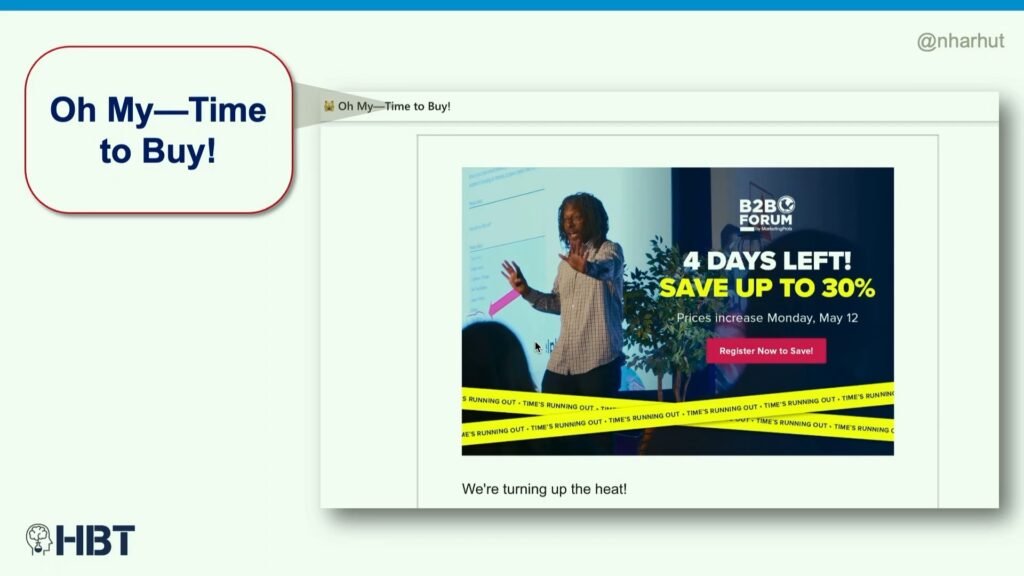
Here we have MarketingProfs again, right? “Oh my, time to buy” in their subject line. They could have said, “Oh my time to purchase.” But “Oh my, time to buy” is arguably better.
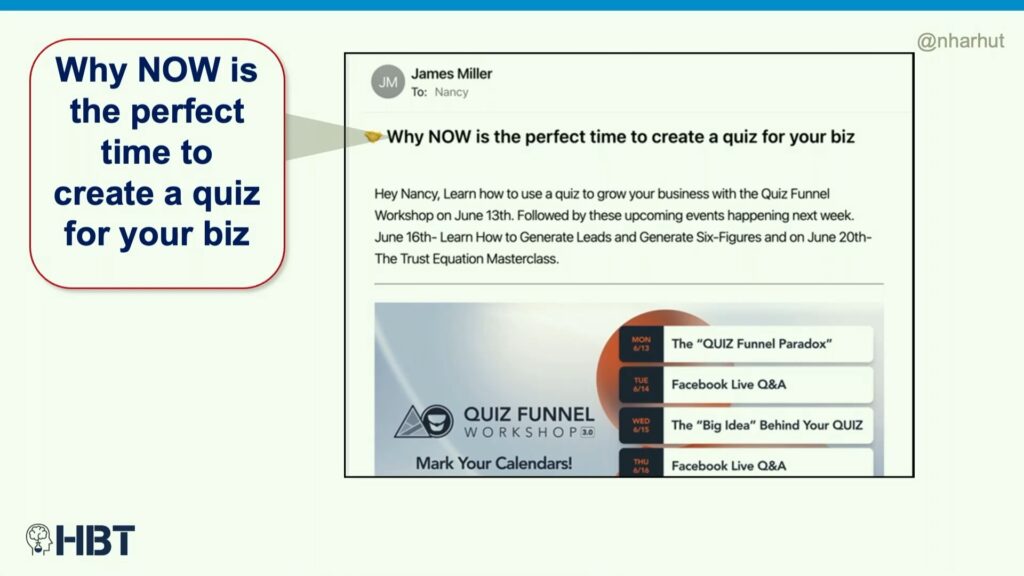
Or here we’ve got, “Why now is the perfect time to create a quiz for your biz?” They get that little rhyme at the end.
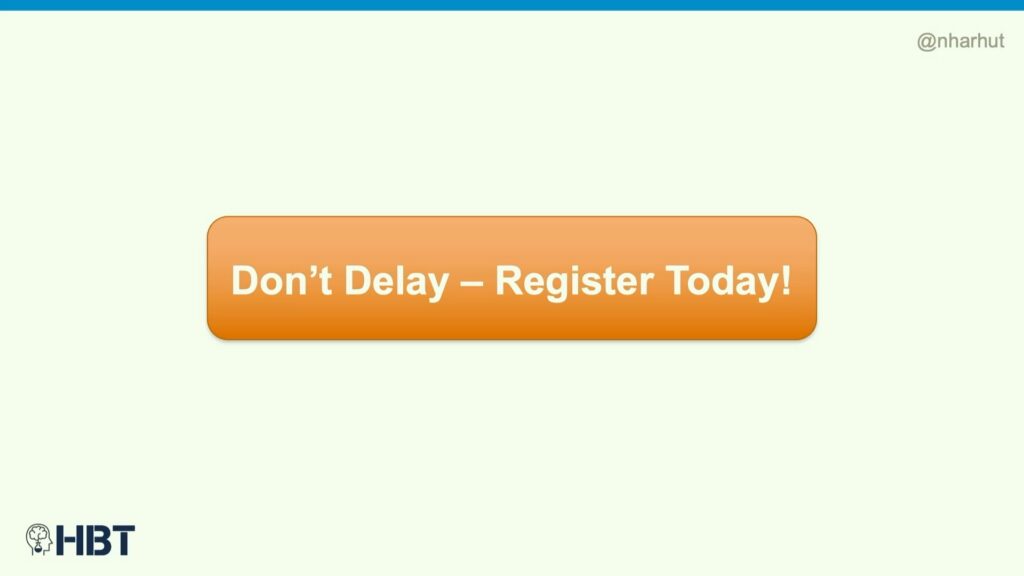
Or even your calls-to-action: “Don’t delay—register today.” They’re not saying, “don’t delay, register now” or, “don’t wait, register today.” All three of those convey the same information, but arguably the one you’re looking at right now is the best of the three because it takes advantage of that rhyme.
So what you want to do is make key messages rhyme. Look for those high-read pieces of real estate: your subject lines, your headlines, your calls to action, your campaign lines, right? Make them rhyme. All right.
The fourth trigger is something called the “psychology of surprise.”
And this is interesting…
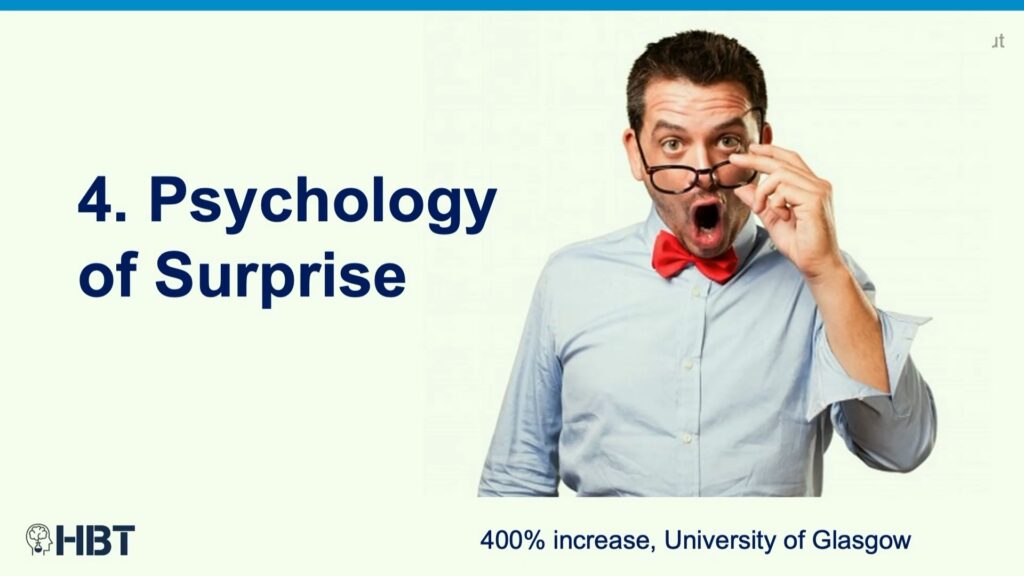
What behavioral scientists in Glasgow, Scotland have found is that when people are surprised, it amplifies their emotions by about 400%.
So why do we care as marketers? Well, we care because when people’s emotions are amplified that much, two things happen.
One, they focus on the thing that surprised them.
And two, they’re more likely to remember the thing that surprised them.
And we’re in marketing, what do we want? We want people to focus on our message. We want people to remember our message.
Surprise allows us to do that. So how do we use it?
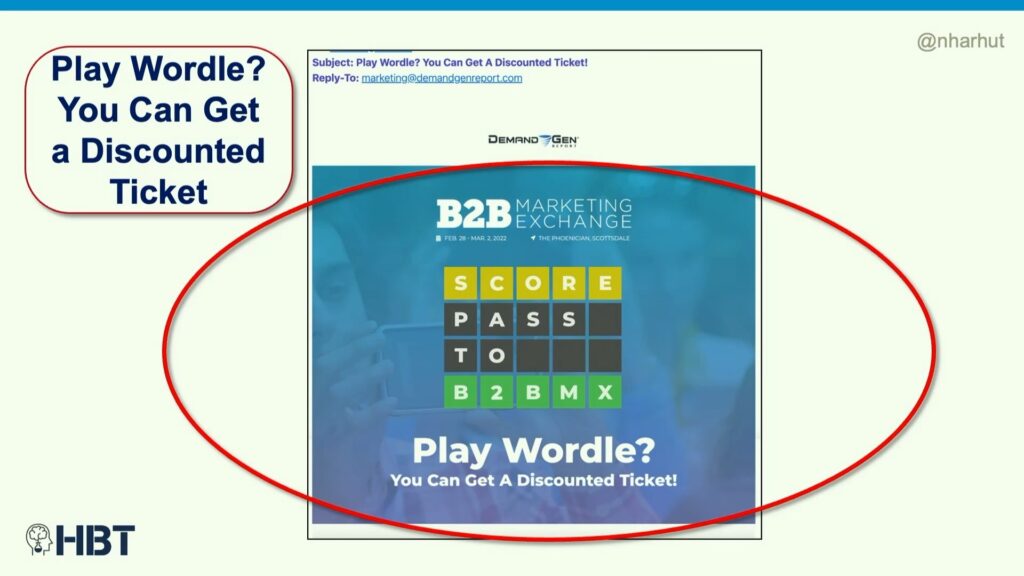
Well, here we’ve got the B2B Marketing Exchange. And they say, “Play Wordle? You can get a discounted ticket!”
And you’re like, “Huh, what? I’ve never heard of that before. That’s kind of crazy.”
When you’re talking about going to a conference or an event or a summit or a symposium, sure, there are discounts available. Usually it’s, “buy your ticket early, you’ll get a discount.” “Register three or more people from your company, you’ll get a discount.” “Be a returning attendee, maybe that’ll get you a discount.”
But you don’t usually see, “do you play Wordle? Hey, you can get a discount to a B2B conference!”
Like, what’s that all about?
But it focuses your attention.
It makes you remember it because you’re surprised. You don’t expect to see that.
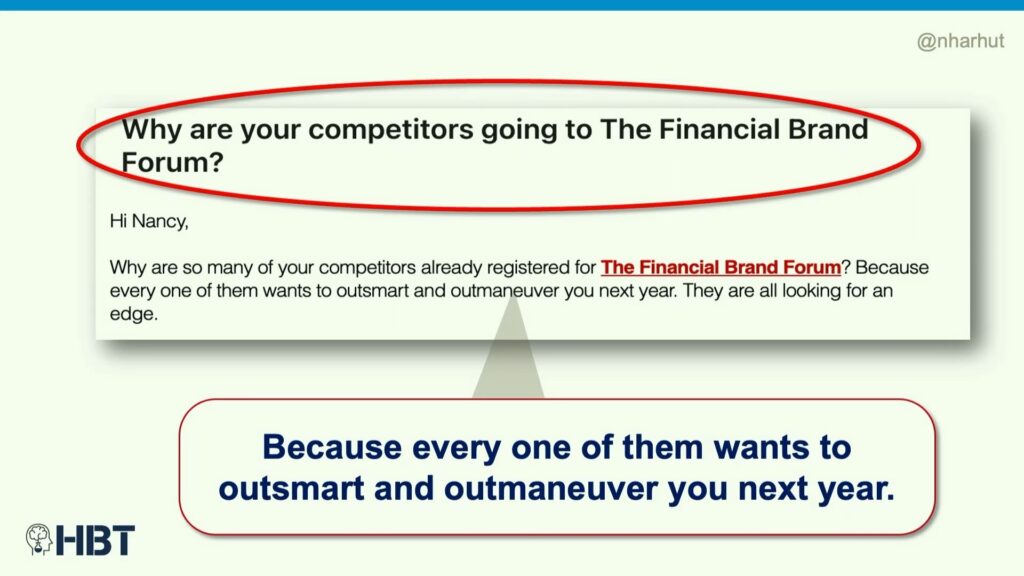
Well, here we have something called the Financial Brand Forum. And they say, “Why are your competitors going to the financial brand forum?” And this is targeted at banks and credit unions.
And the answer is: “Because every one of them wants to outsmart and outmaneuver you next year.”
And you go, “Wow, I wasn’t expecting to hear that! What I was expecting to hear was, ‘oh, why are people going to it? Well, they want to stay up to date on the latest trends. They want to know the current insights. They want to stay on top of where the industry is going. They want to network…’”
All the things that we usually say when we’re trying to get someone to go to a professional event, right?
But they’re being unbelievably authentic: they’re saying every one of them wants to outsmart and outmaneuver you next year.
And it’s like a bucket of cold water hits you in the face and you’re like, “Oh my God, they’re absolutely right. I better go to this conference too, or I’m going to be left behind.”
Here we have something from Content Marketing Institute and they say, “Ship Happens.”
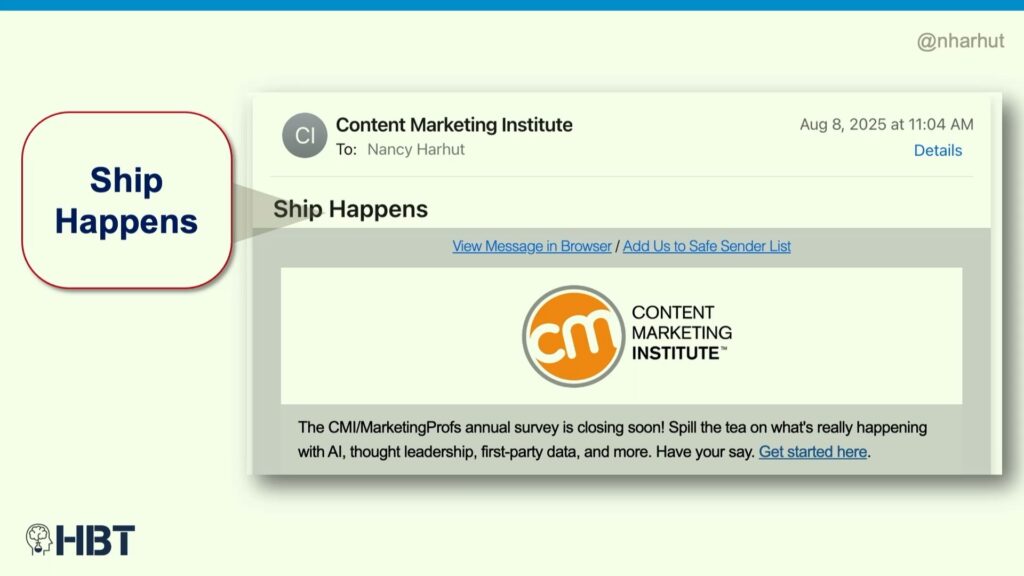
But you double take because “ship happens” sounds very similar to an even more common phrase… that is not that one… but you double take.
You’re like, “Wow, what’s going on here?”
They’re playing off of something else that we often say. And so you double take, you’re surprised, you come back, you pay attention.
So what you want to do is, you want to make your message surprise people.
It could be that your offer surprises people. It could be that the copy you use surprises people. It could be that your pictures, your imagery surprise people, right?
Don’t show the same thing everyone else in your industry is showing. Show something different, something unexpected, or take the thing that everyone else in your industry shows and put a different spin on it so it looks a little different, right?
What you want to do is stop people.
There are so many things competing for your target market’s attention that if you don’t break through, if you don’t stop them in their tracks, you’re not going to connect with them, right?
So surprise them!
It’s a great way to make them focus on your message and remember your message.
Published January 22, 2026
B2B Forum is packed with marketing insights, strategies, and tactics taken from the real world experience of over fifty industry experts, packaged into context you can actually put to use.
Join us in Boston for B2B Forum on November 2-4, 2026. Early buyers get B2B Forum tickets at their lowest rate, and discounted hotel rooms are available while they last.