Podcasts! YouTube channels! Live LinkedIn events!
You have many ways to reach your audience.
But before you begin, you should ask:
What do THEY want to hear?
And how do YOU stand out from the crowd?
Harry Morton, CEO of Lower Street, revealed how his company thinks about these questions at B2B Forum 2025.
Before you hit record, listen to Harry’s advice now, or read the transcript below!
This coming November, 800 B2B marketers will gather in Boston for B2B Forum! Join your people for good food, better networking, and over 50 great sessions to inform and inspire you to be the best marketer—and human—you can be. Tickets are 40% off and available now. Click here to get started!
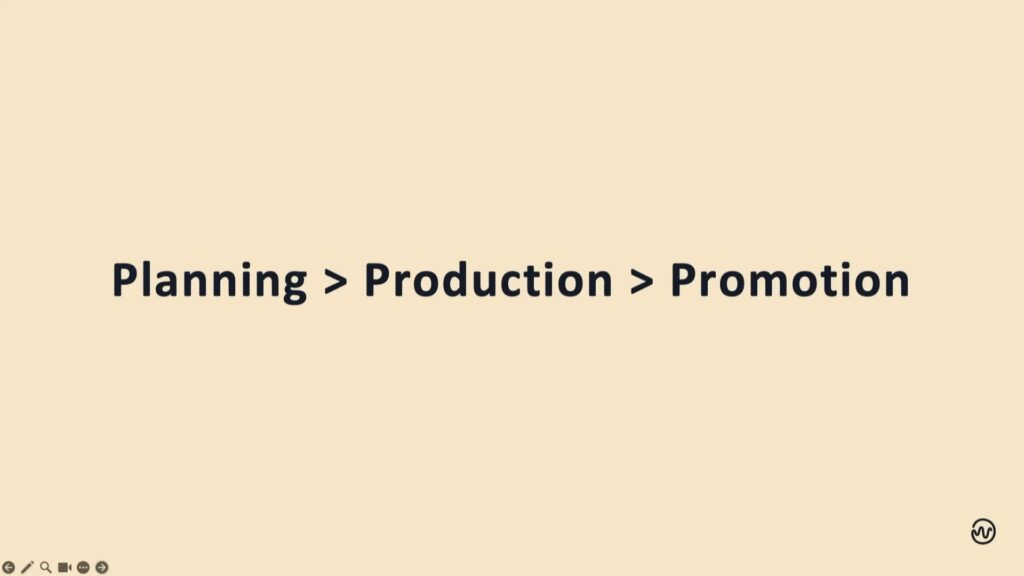
We break the sort of creation of a podcast into three main buckets:
The planning, the production, and the promotion.
Most brands will start kind of somewhere in the middle where they’ll say, “okay, we’ve got this amazing idea. We’re going to do a podcast. We’re really excited about it. We’re going to invite these guests on. Let’s get into recording some things. We’re going to do an MVP”—which is my least favorite word in podcasting, unfortunately—”and then we’re going to put it out.”
Then they get those results that we’ve all experienced and they go, “oh, panic, panic, panic… Let’s promote it!”
But it’s in the planning where we have the most impact.
The biggest impact we can have on the end result is in the strategy and the work that we put up front, which is what we’re going to go through just now.
When you start by making something that is in whatever format you develop to begin with, and you put it out there, it becomes incredibly hard to then change the course of that show. It’s much, much harder to change once you’re up and running, than it is to just plan from the beginning.
And you know what this is like?
This is like my cows. Obviously. This is Eliza at the front. Isn’t she gorgeous? But she is the matriarch of her herd. She’s very, very much in charge. And when she decides which direction she’s walking in, I mean, I dunno, maybe you can do better than me, but ain’t no changing her mind.
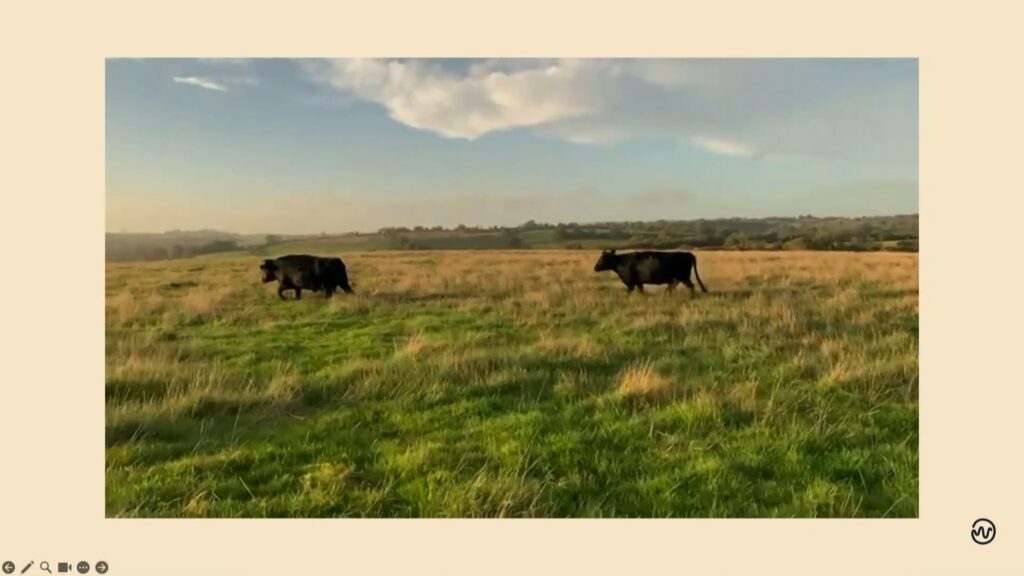
She’s going where she’s going.
So yes, it’s much harder to change once you are up and running.
If planning is where we need to be, how do we plan a good podcast?
How do we come up with some ideas that aren’t completely overwhelming and unachievable?
Well, where we need to think through are these three areas. Most brands, most companies and marketers, will begin with “me.”
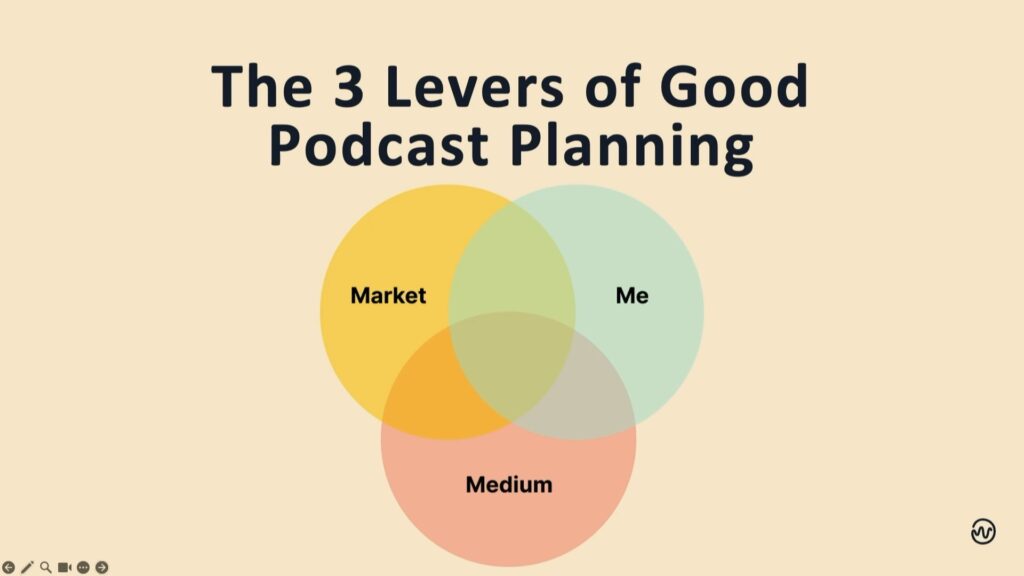
“This is what we’ve got to talk about. These are the guests we want to do. This is what we want to get out of it. Go. Let’s get started.”
But what I really want to encourage everyone to be focused on and obsessed with is: market. Our target listener.
We’ve got our target listener, the market. We’ve got me, the brand. And we’ve got medium, our competitive landscape, which I’ll get into in just a moment.
We’ll begin with the market.
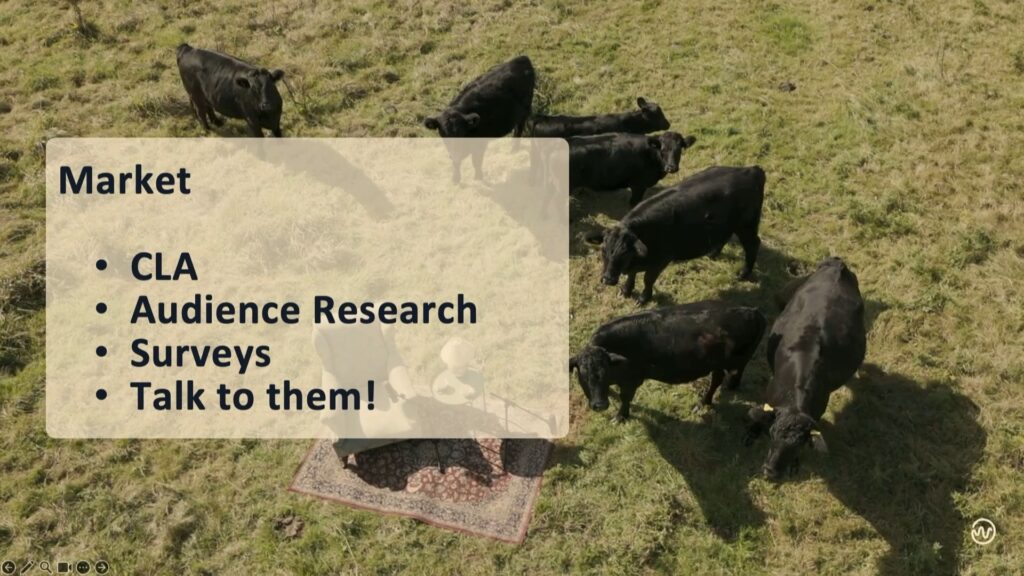
We want to understand our listener as deeply as we possibly can. We want to do our audience research and… well, I guess this is one of the first sessions of the week, so maybe you haven’t heard “know your target audience” a thousand times yet this week. But I can feel you rolling your eyes. I certainly would be. So let me be a little bit more concrete.
Basically, competitive landscape analysis, CLA.
This is the neighborhood within which our new podcast is going to live. And we want to build that up by understanding what our target audience is listening to.
We want to do some audience research. I love a tool called Spark Toro, which I’m sure many folks in here will have heard of already. Spark Toro is an amazing resource where you can look up the target audience you’re looking to serve, and get just a ton of insight into the sources of media and influence that they are influenced by. Things like the topics that they’re interested in, the websites that they visit, the social media channels that they follow, the YouTube channels that they follow.
And yes, the podcasts that they listen to.
This will show us a bunch about all of those different factors. All really important, but the shows in particular are obviously incredible.
These are the types of podcasts that this audience is sharing on social media, talking about, and excited by.
This gives us a real insight into what we need to do.
And just like Deb, we need to survey them. We need to talk to our audience, ask them, “what podcasts do you like? What do you listen to?”
Because our audience is much more than just the data points of what Spark Toro tells us.
They’re also fans of like, we learned, true crime. They might be comedy podcast fans. They might be sports fans.
We want to understand the full spectrum of their media consumption habits, because if we’re going to serve that audience and really get them excited, we have to understand them and know them.
So we start with the market first.
Then we move on to ourselves.
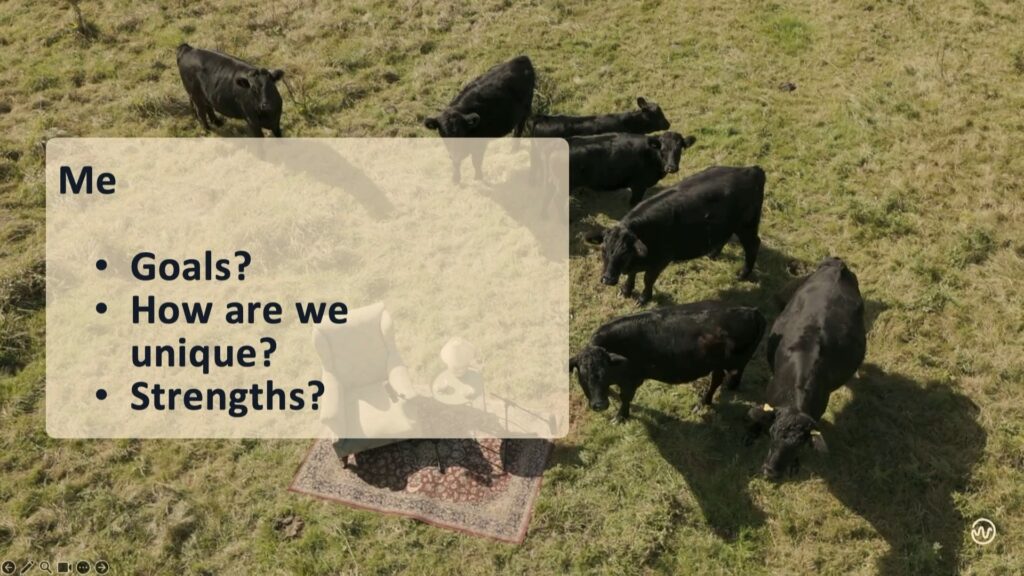
Why are we doing this in the first place? Why do we want to podcast? What do we expect to get out of it?
Our goals will have a massive impact on the kind of format, the sorts of show that we develop.
Because for example, if we want sales tomorrow, we need a very different kind of podcast than if we want brand awareness or brand lift.
GE did a show many years ago called The Message, and it was an audio drama. There was no mention of any product in it whatsoever. It was just a story for a story’s sake, I suppose like the soap operas back in the day.
And it was a huge success.
They got to spend hours a week with their target audience just associating their brand, the GE brand with good stuff, good entertainment, and that was a huge win for them.
So whatever kind of outcomes we want will impact the sort of show that we want to make.
And then we want to think through, “how are we unique? What can we bring to the table that nobody else can? What access do we have that nobody else does? What unique point of view do we hold that the rest of the world might not necessarily agree with?”
Because if we are not thinking differently—again, just like those FinTech shows we looked at earlier—then why would someone pick us over somebody else?
And, “what are our strengths? What do we have access to that other people don’t?”
But also we talked about the difficulty of hosting a podcast.
I’ve worked with some brands before who literally have people on the team that were NPR hosts. And so they had this phenomenal strength, which was a genuinely talented host in-house.
That might not be the case for most of us. And so we might think about outsourcing. I think something that enough brands don’t think about is, “why don’t we just get someone outside to host our podcast? We can align ourselves with that person and their audience, because it’s a huge lift.”
So we want to think through what are the things that we have, the bandwidth, the budget, whatever those strengths are.
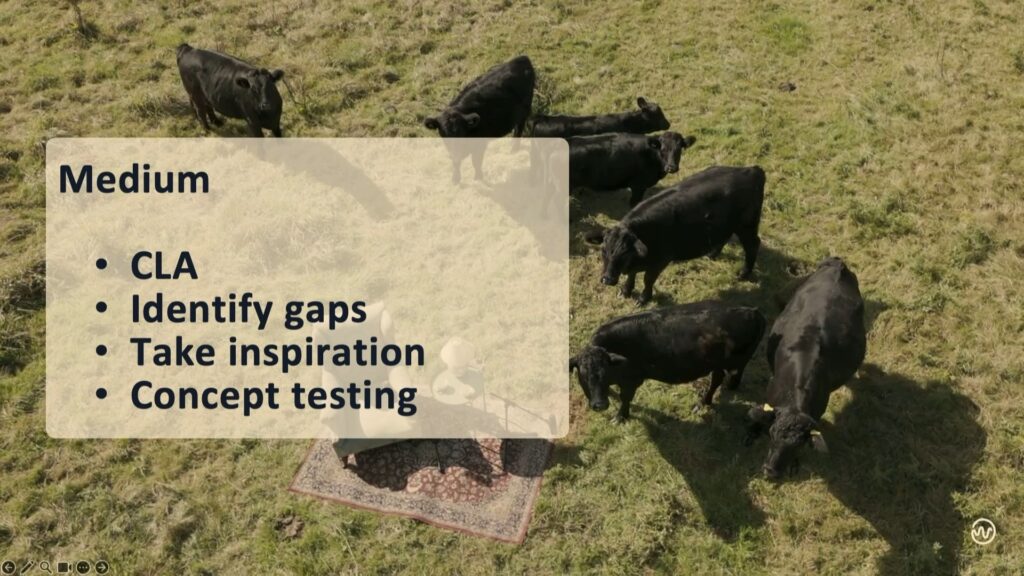
And then we want to come back to our competitive landscape analysis.
The medium: we’re looking at what we are competing with, in the fullest extent.
And so we’ll bring in all of that research we’ve done on our audience, what do they like, what are they listening to?
But also we’re content marketers. We think about SEO. We want to understand it from a search perspective, the keywords that we want our show to be surfacing around.
If we type them into Apple Podcasts, so if we’re a FinTech show, we type in FinTech, what are the shows that come up, and what are we there competing with there?
And there are some really great tools to do this, by the way, PodSearch.com, just Google “pod search.” BrandsInAudio.com is a website we put together, which houses all of the branded podcasts that are out there.
There are a bunch of different resources you can use to understand that competitive landscape.
And once you’re looking at that and you have it, you have the audience in mind, uou know what you’re trying to get out of it, and you know what your competitive landscape is…
You can look for gaps.
Where is this audience that we’re looking to serve not already getting what they want? Where can we stand out and do something that they’re being underserved in or do it differently or better?”
Also, “where can we take inspiration? What’s working? What can we see among the best performing shows in our space that we maybe want to incorporate?”
Because clearly the market’s telling us, “hey, we want this kind of information.”
Also, “great artists steal…” whatever that saying is. (I should have stolen it better, I suppose!)
But look at adjacent industries.
For example, if we’re in FinTech, well, why don’t we look at the healthcare space?
If we can see a podcast in healthcare that’s like a really interesting, innovative format, well, we can take inspiration from that and we’re not going to be cross-pollinating audiences there.
That’s something that I think not enough people do.
And then if we want to de-risk ourselves at this point, if we’re feeling like, “Deb, hold on, this feels pretty scary. I’m about to make a true crime show. I’m going to look like an idiot and get fired…”
Well, we can concept test, and there’s a bunch of different ways that we can do this.
Certainly creating a pilot episode of one particular concept can be a great way to understand, “hey, can we do this? Does it land? What’s the response?”
But also, we can do it really scrappily.
We can run Facebook campaigns with a few different creatives and see which one lands the best, different titles and artworks and things like this. Or if we’re the Deloittes of the world, we can work with, of course, research companies who can run focus groups for us.
But if we’re really thinking, “okay, we want to make something that’s a bit different, this feels kind of scary, how do we de-risk that?”
Well, I would say testing those ideas before you go live is a good idea.
Published February 5, 2026
B2B Forum is packed with marketing insights, strategies, and tactics taken from the real world experience of over fifty industry experts, packaged into context you can actually put to use.
Join us in Boston for B2B Forum on November 2-4, 2026. Early buyers get B2B Forum tickets at their lowest rate, and discounted hotel rooms are available while they last.