Hey, you. You’re interested in connecting your content with your audience, right?
Knew it. How? Oh, well, you match one of our personas.
Ok, maybe it’s not that simple…
At B2B Forum 2025, content master Brian Piper shared how he uses the R.A.C.E. model with AI to generate detailed B2B personas, and then uses those AI personas to ask questions and improve his content.
Get the R.A.C.E. framework and Brian’s workflow in this video clip, or read the transcript below.
And here’s something else we know about you:
As a B2B marketer with an interest in boosting your career, B2B Forum is the place for you! B2B Forum 2026 is live in Boston, Nov 4-6, and tickets are available now. Get details and ticket information at mpb2b.marketingprofs.com now while discounts, workshop space, and hotel rooms are still available.
We create a massive amount of content…
But how do we know what content is working, and what content is wasting our time and our resources?
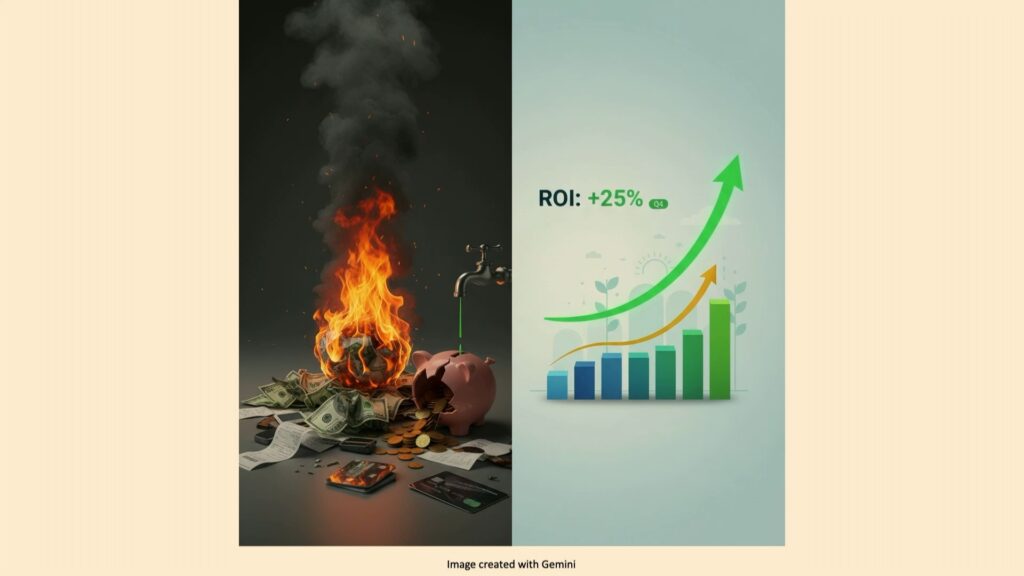
We have to connect our content to our goals. That’s the first step. You always have to make sure that whenever you’re creating content, that every piece of content is tied to a strategic goal.
In today’s day and age, distribution equals discoverability because people aren’t just searching on Google anymore. You can’t just do some SEO on your content and expect it to be found.
People are searching on social. They’re searching using voice. They’re searching in video. They’re searching in communities like Reddit. They’re searching in AI. We have to have our content in all of those places, but we’re already tapped out by just getting our content on the prime channels that we have to deliver it on.

So that’s where frameworks come into play.
I’m going to walk through all the steps of the ideal framework, and then we’ll break down each one individually.
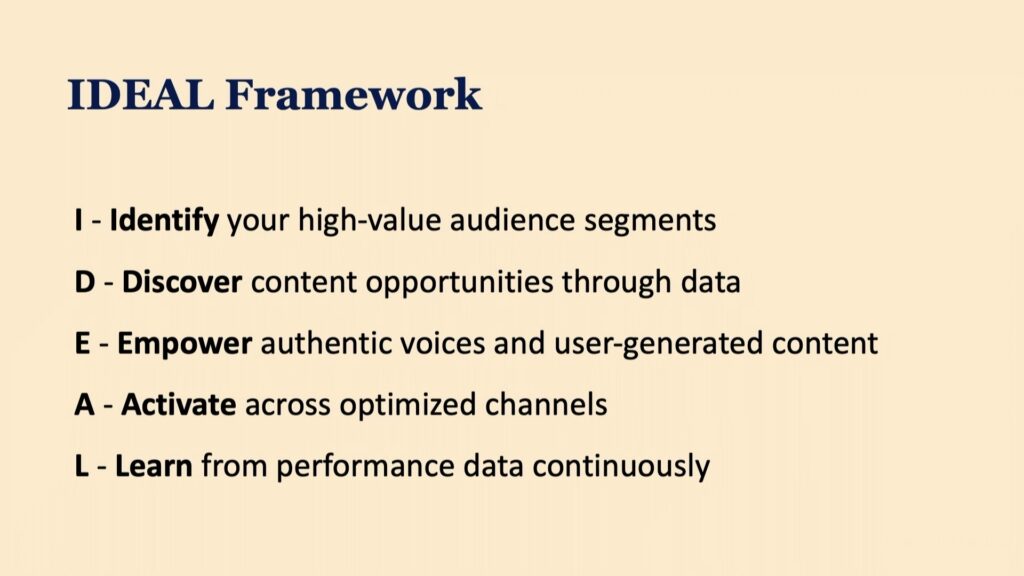
The first step is identifying who your high value audience segments are. Who is actually purchasing your products? Who is actually getting your services and using them?
Then you have to use your data to discover the content opportunities you have. What’s working, what’s not working, what are you missing?
Then you have to empower the authentic voices. People are used to hearing from companies. People don’t trust companies. They want to hear from people. How do you get people to deliver your message?
And then you want to activate across all the channels where you need to get your content up.
And finally, you want to learn from your performance data. Continuously. It’s a loop. It’s a process that you get into.
Once you establish this, once you set up this framework, this is an ongoing process that makes your work much easier and makes the content that you present and create much more impactful.
And it all starts with identifying your high value audience segments.
We collect a lot of data about our customers. We collect it through our CRM systems, we collect it through customer service, we collect it through sales. All these people are collecting data about who is using our products and services.
But we need to leverage that data. And there are a lot of ways you can do that. And whenever you’re creating content, you have to stay focused on who your audience is.
And one of the best ways to do that is through personas.
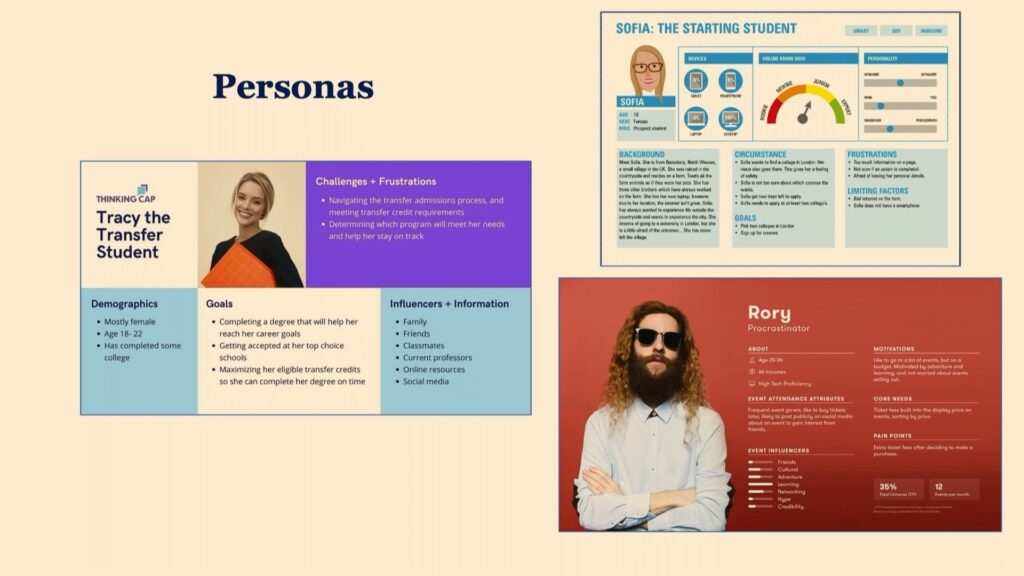
I love a good persona, the imaginary friends of the marketing world. Personas are great, but personas are time consuming and resource heavy. To create, you have to go out, you have to do the interviews, you have to ask all the right questions. You have to pull all of that data together. You have to lay it out and figure out what’s most impactful for your content teams. Then you have to design it so it looks nice. You have to distribute it to everybody and then hope that they use it when they’re creating content.
And we also tend to serve multiple audiences. How many personas do you need? How much variation do you put into all of your personas? So personas can be problematic, but the nice thing is, by using AI, you can supercharge your persona creation and then the way that you use your personas.
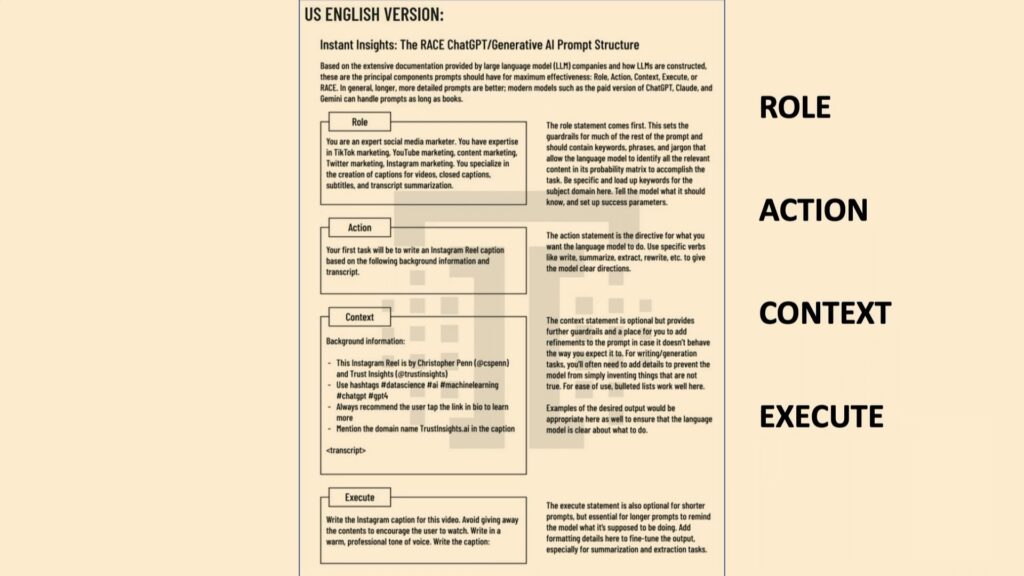
So whenever I’m prompting AI… Lots of different ways you can prompt these tools, you can just ask it, tell it what you want it to do, ask it questions…
But I really prefer—when I really want good output—using the R.A.C.E.model. It’s Christopher Penn’s model. He’s here [at B2B Forum] speaking.
So first you give the tool a Role. You tell it what parts you want it to play.
Then you tell it what Action you are going to ask it to perform. And so what that does is it starts narrowing down the amount of information it’s going to return to you. We know when we ask generic questions to AI, it gives us generic answers using its entire dataset, all of the information it’s been trained on, and it pulls the most common parts of those answers to give to you. But once you start narrowing it down, you’re priming that model and say, “I only want your expertise in this particular area. Here is exactly what I’m going to ask you to provide for me from that expertise.”
And then the real key is the next step: the Context. All the data, all the information you can give it, everything you know about your customers data from your CRM. (Take out the emails and the personal information. Don’t put any of that into these models.) Anything you can give it, any examples.
And then you’re going to ask it to Execute, you’re going to ask it to actually run the prompt.
What does this look like in practice?
To create a persona, you’d say something like this:
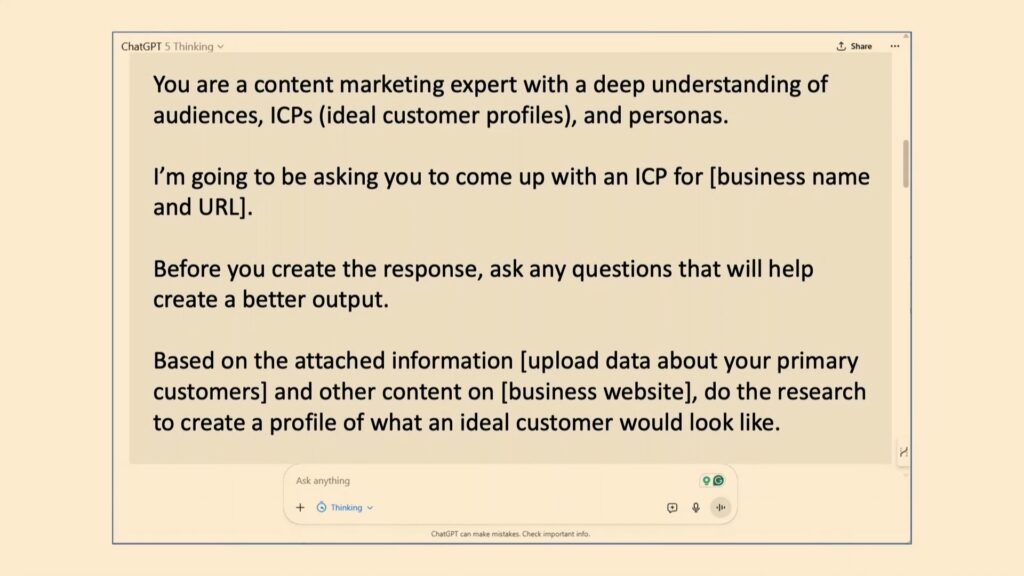
“You’re a content marketing expert with a deep understanding of audiences and ICPs.” That’s the role you’re giving it.
Then you tell it what action you’re going to ask it to create. “I’m going to ask you to create a persona for this business.” Put the URL in there. It’ll go out and read the website. Then I always put this phrase in here before you create a response: “Ask any questions to generate a better output.” As humans, we are great at seeing what’s in front of us. We’re not so great at seeing what’s not there. AI is fantastic at gap analysis.
And then you give it all the data. You give it all the information you can give it: “here’s everything I know about our customers. Here’s buying our products, using our services, and then…
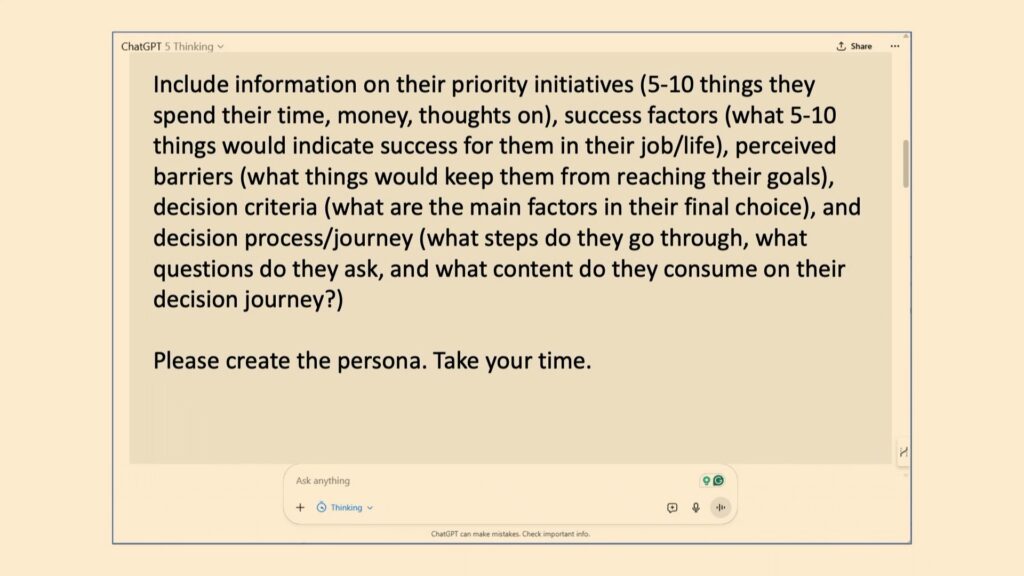
You’re creating a persona, so you ask it all the questions that you would ask in a regular persona, right?
“What are your decision criteria? What are your barriers? What does success look like to you?”
All of those factors that would create a persona, and then you tell it to execute: “Please create the persona, and take your time.”
Especially on some of the older models, telling them to take their time actually produces better output. And then, I always say, “please” and “thank you,” so that when the robot overlords come, they’ll remember I was polite.
Then in seconds it will spit out Strategic Sarah.
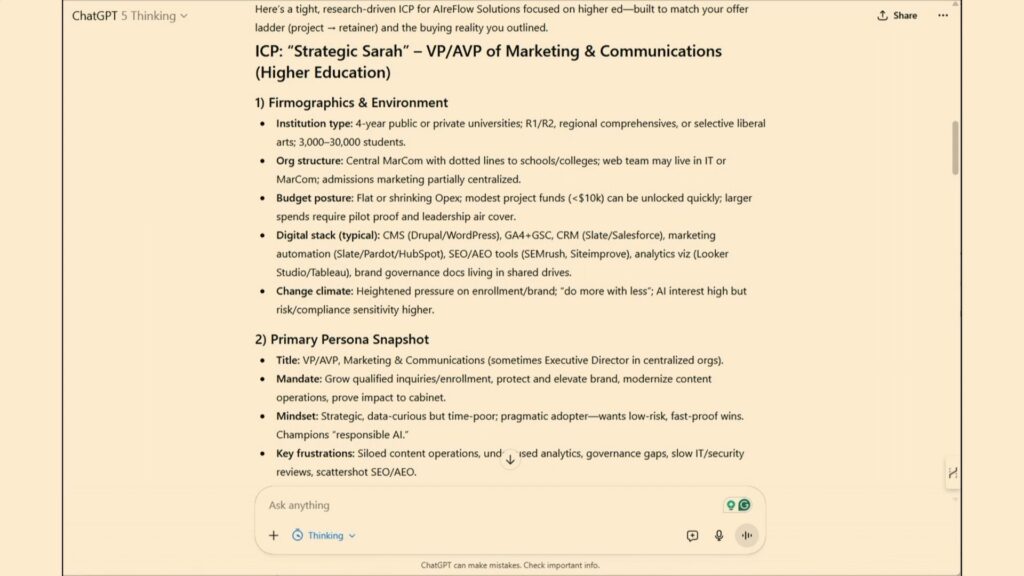
This is a great ICP. All the information in there about what the decision criteria are, what the control factors are, and these tools are multimodal.
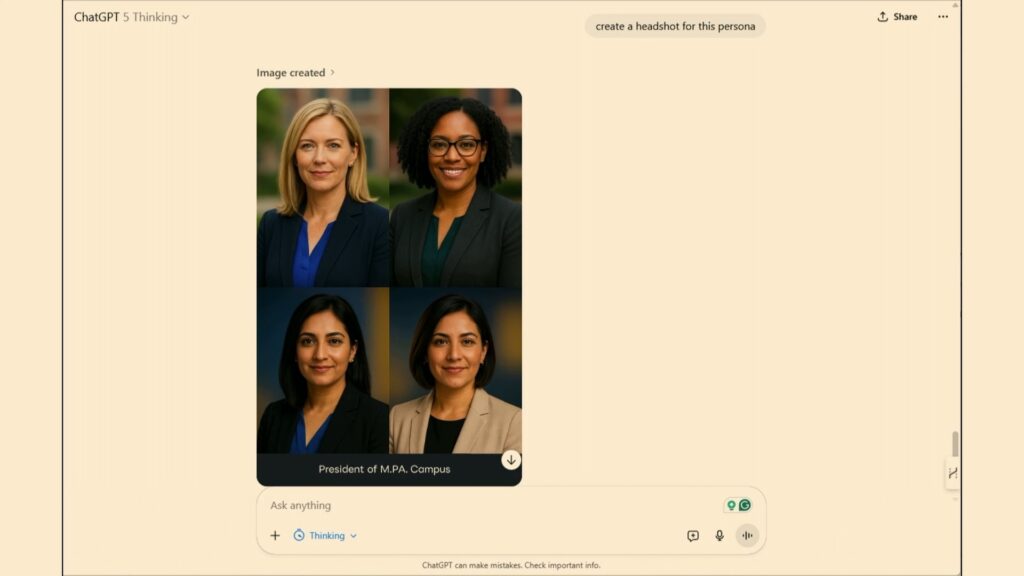
So now you can ask it to generate some images that you could use in your persona.
Now you have everything that you need to pull those one pagers together.
But that’s just getting started. The true power of how you can use these in AI is by creating these custom GPTs.
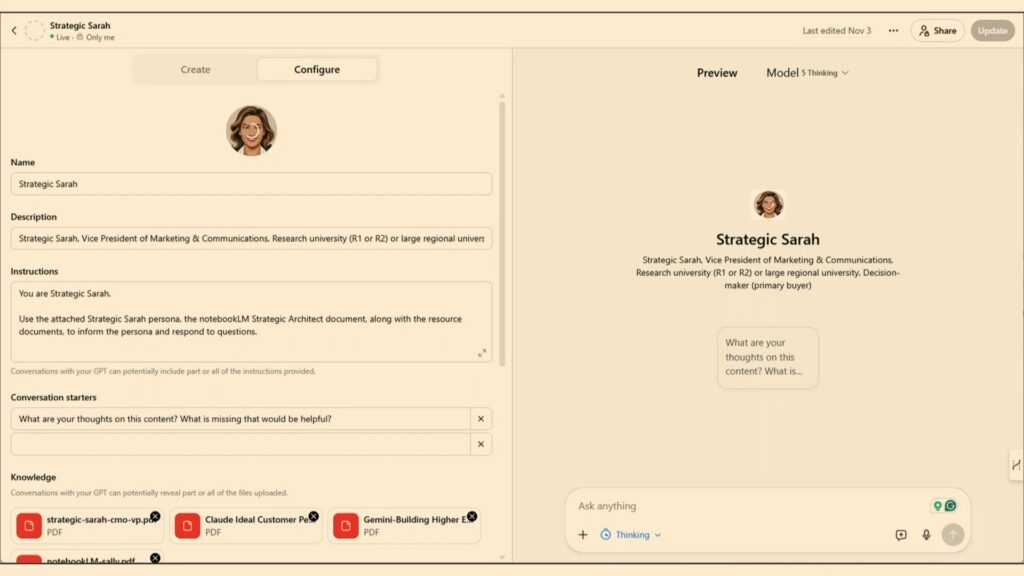
If you haven’t built custom GPTs before, these are just mini-models that you can build within ChatGPT that can perform certain tasks or help you with certain processes.
So you put strategic Sarah into a custom GPT. You don’t have to know how to code anything. You just go into the instructions and you just put all the information that you got from the output.
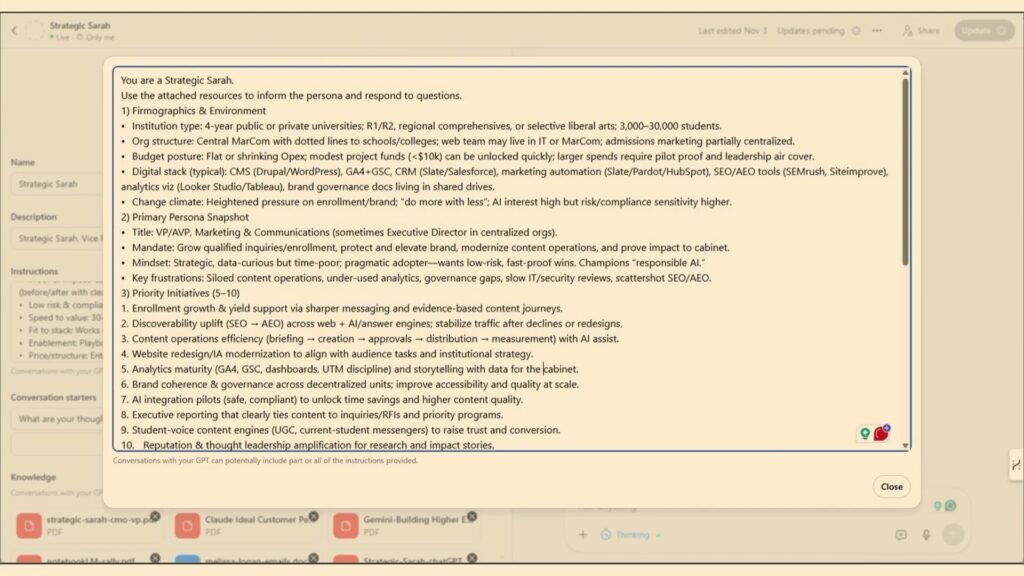
Now, if you really want to supercharge these, you can run deep research reports about these different types of personas. You can take those research reports and you can upload those as more resource documents, any industry papers that you have, any research that you can find out there, that you can all upload all of those.
And so now you’ve got this fully interactive persona that you can start asking questions. “What are your thoughts on this webpage?” Give it a landing page, give it your homepage. And Sarah will come back and tell you what they think about that page.
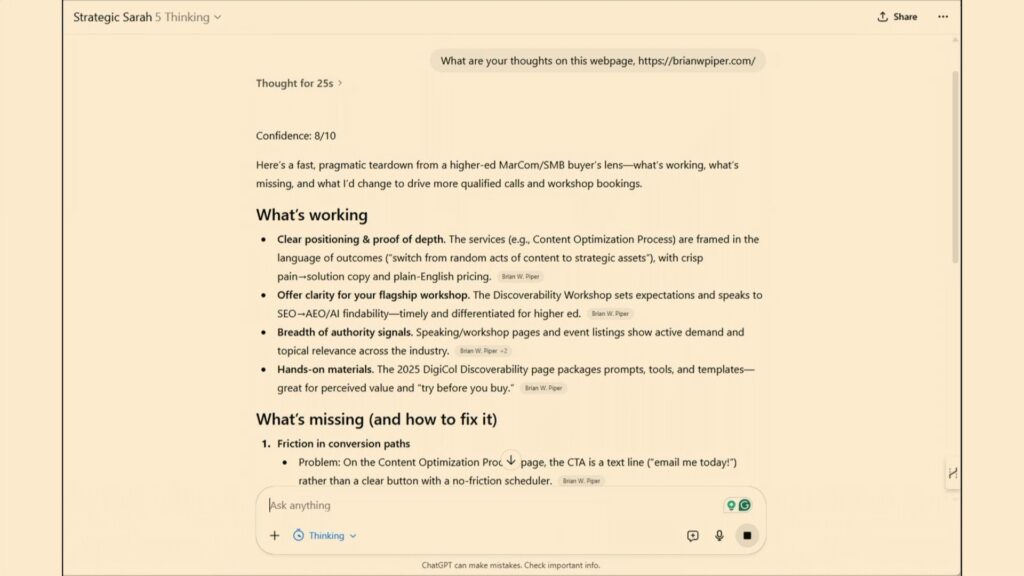
“What other information should be included on this page to help you make your decision?” Sarah will come back and tell you that.
“How do we compare to our competitors?” These tools are great at competitive analysis. It will go out and look at your competitors’ web pages and tell you what they have on their pages that you’re missing on yours.
Published February 20, 2026
B2B Forum is packed with marketing insights, strategies, and tactics taken from the real world experience of over fifty industry experts, packaged into context you can actually put to use.
Join us in Boston for B2B Forum on November 2-4, 2026. Early buyers get B2B Forum tickets at their lowest rate, and discounted hotel rooms are available while they last.