
Nothing builds trust like proof!
And published, original research is proof that your brand is a leader, says Lee Odden.
Lee shared 6 pillars of relevant research that drives demand and revenue at B2B Forum 2025.
Watch a clip from Lee’s session or read the transcript below.
For even more ways to build your marketing position, attract leads, and fill your pipeline, join your B2B marketing peers at this year’s B2B Forum, Nov 4-6, 2026 in Boston. Tickets and hotel space are limited. For more details and to get your ticket before prices increase, visit mpb2b.marketingprofs.com.
How do you become a “Best Answer Brand?”
Well, you’ve got to create an answer engine, and that’s what I’m going to talk about.
You can do that through conducting original research, following a particular framework.
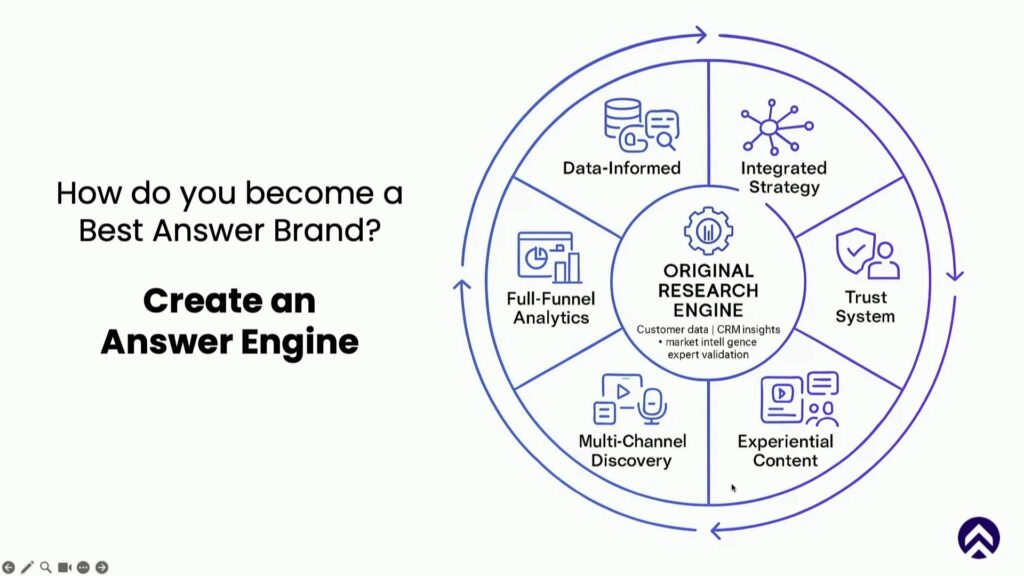
So what we did with our research report is, we reconciled the data that we found from that survey of those 797 B2B marketers against a framework that we use broadly.
And there are six drivers of this answer engine framework.
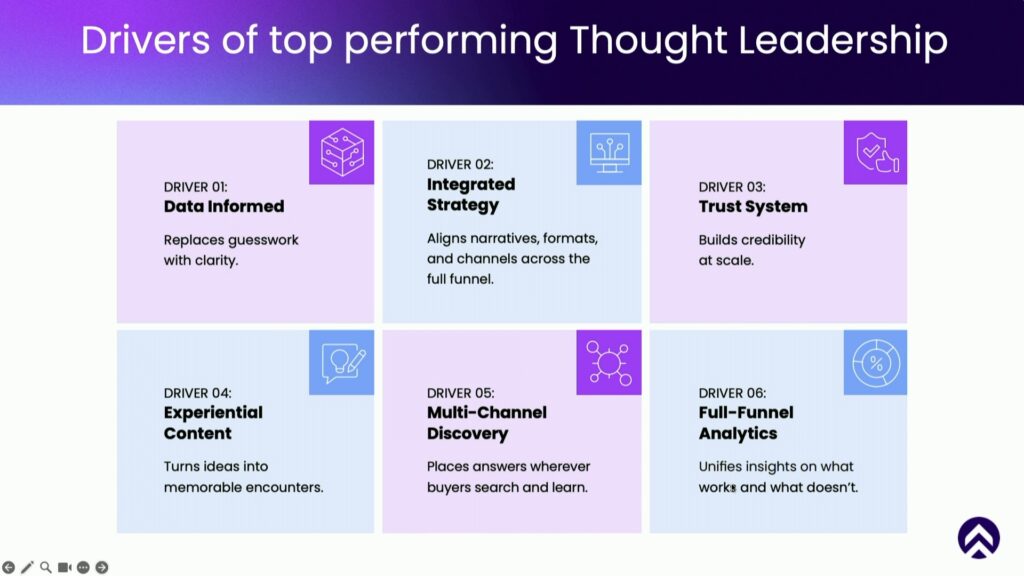
I’m going to drill down into each of these if that’s okay, give you some examples and a little bit of a preview of the report.
So, in terms of data-informed… Cindy [Anderson] says, basically, “if you don’t have a foundation of data, you’re really just publishing opinion.”
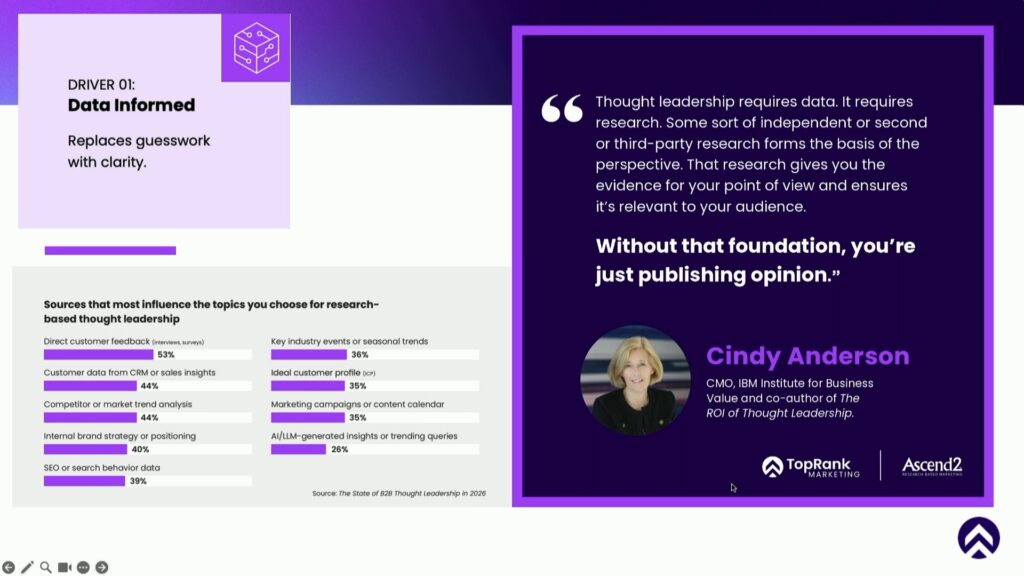
And that’s why I’m so critical of these other content marketing tactics posing as thought leadership. They’re not based in data!
If they’re not based in data, it’s really not thought leadership. It’s just publishing confident opinion. And there’s a time and place for that, but don’t expect the same outcomes as you might get from a truly credible, trustworthy, and validated piece of content.
In our research, we asked, “what influences the topic you choose from to do your research?” And the number one answer was about direct customer feedback.
And there’s a lot of data sources you can use to inspire, “well, what are we going to do our research about? What are we going to do to construct the narratives out of that research for our demand gen campaigns that we build as an extension of the research report?”
So the examples I’m going to give you are through this lens of a… I had to think of a hypothetical, because no client would let me share detailed information on every single one of these six pillars.
So, “a private 5G network solution.”
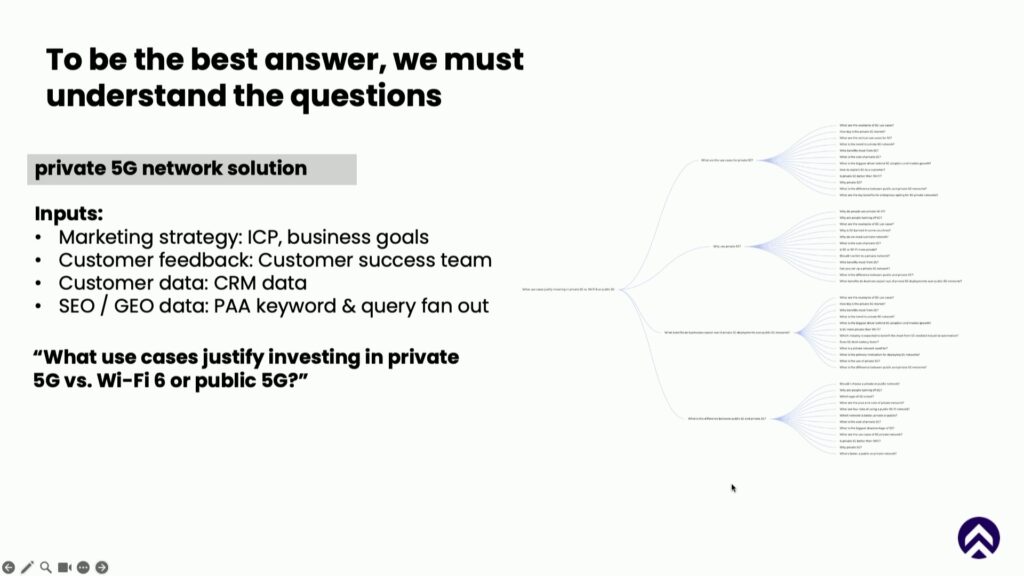
I don’t know if anybody works in Philophany or has 5G as part of your solution mix or whatever. But anyway, “so what might be some of our inputs to decide, as a 5G network solution provider, to decide on our research?”
We’re going to obviously look at our marketing strategy. What do we want to be known for? What’s important to our ideal customer profile? What are their preferences?
But we’re also going to talk to customer success and find out what kinds of questions and interactions are happening, what problems are they having or whatever.
We’re going to mine CRM data, which is wonderful to do with AI tools these days.
And we’re also going to use SEO and GEO data, things like “people also ask” tools and also “query fan out” simulators.
Now, I don’t know if you know what a query fan out is.
But in AI search, when you type in a question or a query, it’s not just looking for that one thing.
What it’s doing is it’s going to predict a whole spectrum of related questions and it’s going to search on all of that and reconcile all of that data into the search results.
So, understanding what that spectrum—or the predictive questions you might ask, outside of the one question you’re popping in—could be quite useful as you construct your answer engine and become the best answer for your customers.
In this case, let’s say that one of the questions we’re leaning into is, “what use cases justify investing in private 5G versus WiFi6 or Public 5G?”
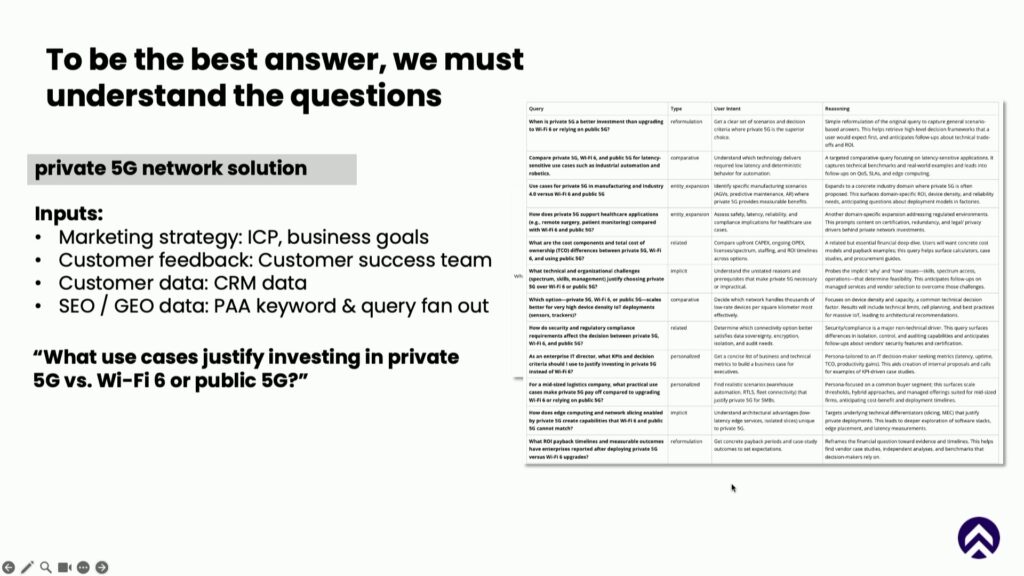
And so we can bring that question into a… again, in this case, I’m showing an example of a query fan out simulator, right? So we can pop that question in and it’s going to give us all these recommendations in multiple levels and we can drill down into specifics.
And then we can build out that list and add context and even add category entry point data to help us validate, “okay, which of these questions is most relevant for our customers that we can cluster and use as inspiration for actually conducting our research?”
Does that make sense?
Because one of our outcomes that we’re looking for with this research is, of course, findability, but number one is relevance.
So we conduct our research, we collect our data, we have our insights, and away we go.
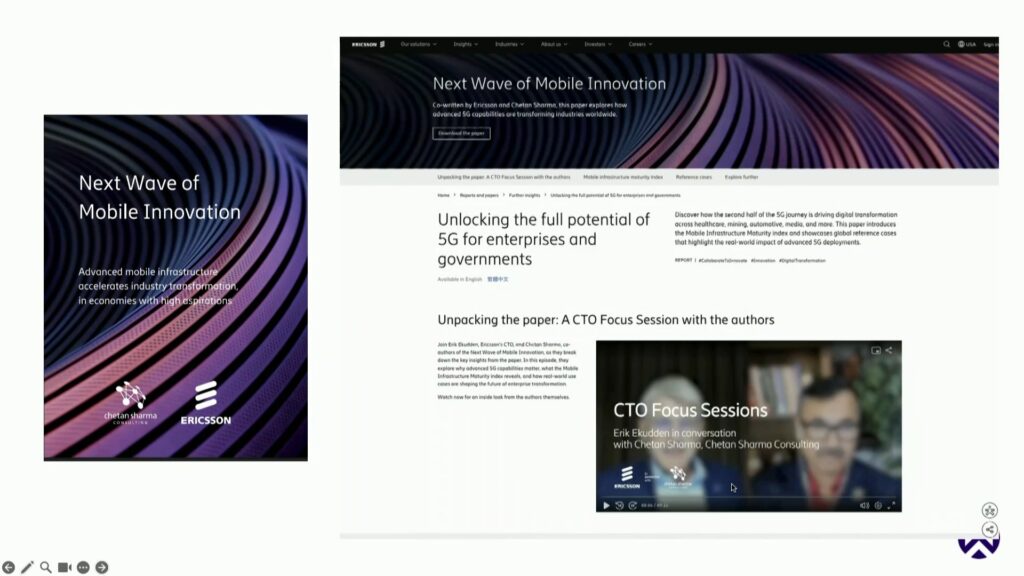
Ericsson, 5G provider, okay, I don’t think it’s any surprise that the breadth and depth and frequency with which Erickson publishes original research on 5G topics—by the way, this is a great example of an experiential research report with the tool and the embedded video—but it’s no surprise that they’ve got great organic Google search visibility and they also have great AI search visibility—perplexity, ChatGPT—on an expression like that.
The data you use to inform your research obviously should be number one relevant for your customers as if you have no barrier to getting the information in front of them.
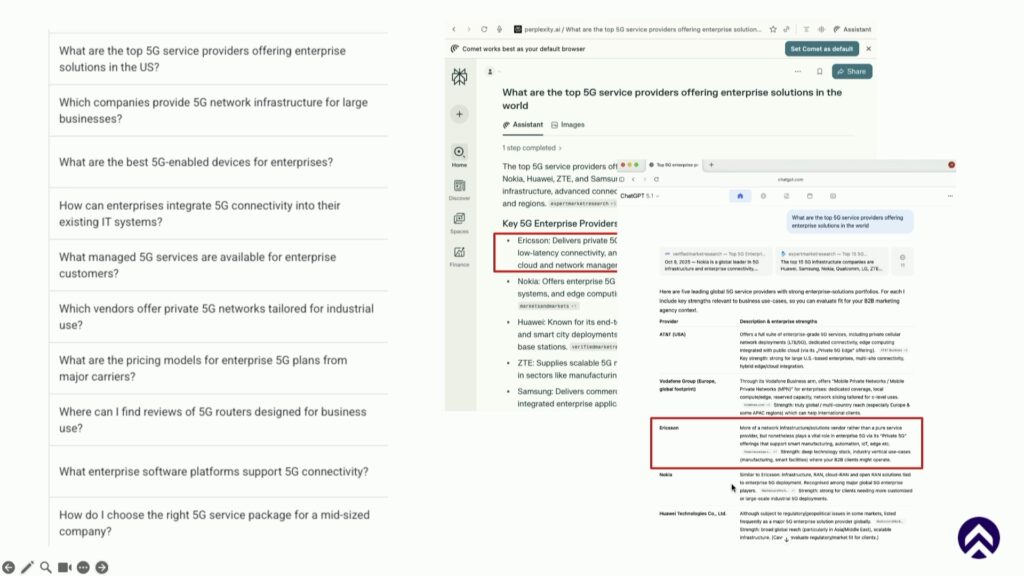
But you’ve also got to think about ideas that travel, ideas that are being searched for, and that can help improve the effectiveness.
Because what is great research unless people can find it.
Published February 12, 2026
B2B Forum is packed with marketing insights, strategies, and tactics taken from the real world experience of over fifty industry experts, packaged into context you can actually put to use.
Join us in Boston for B2B Forum on November 2-4, 2026. Early buyers get B2B Forum tickets at their lowest rate, and discounted hotel rooms are available while they last.