Demand Gen?
Growth Marketing?
Omnichannel? Multichannel??
Which is it you do… and what are the differences?
Make it all make sense with this clip from Sabina Iyengar, Founder and CMO of Integrated Growth Marketing Services, from her presentation at B2B Forum 2025.
And if you want to continue making sense of B2B marketing today, B2B Forum is the place for motivated marketers like you!
Join your peers in Boston this November 2-4. Discounted tickets and workshops are available now. Click here to get started.
There is a misconception that demand gen and growth marketing are one and the same.
And not too long ago, we used to say lead generation and demand generation were the same.
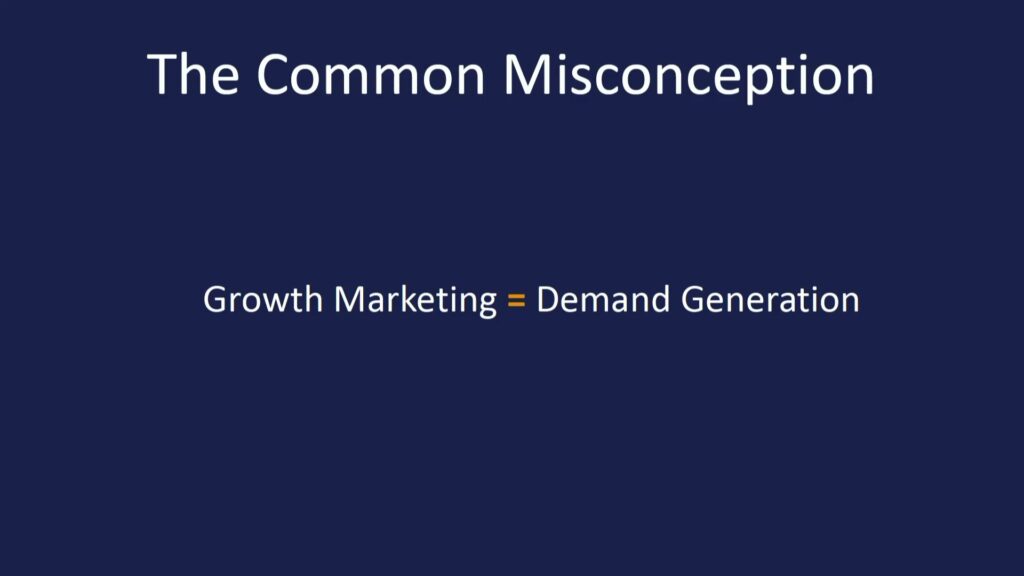
I feel so bad for demand generation, because they’re either overstated or understated. But nobody really truly understands. So I really want you guys to take a look at [these definitions.]
I’m big on definitions. You’ll find out later, but I am a scientist at heart.
I need true definitions because otherwise people are just assuming something of what you’re saying and you really don’t know what they’re saying. So I will be very clear in my definitions.
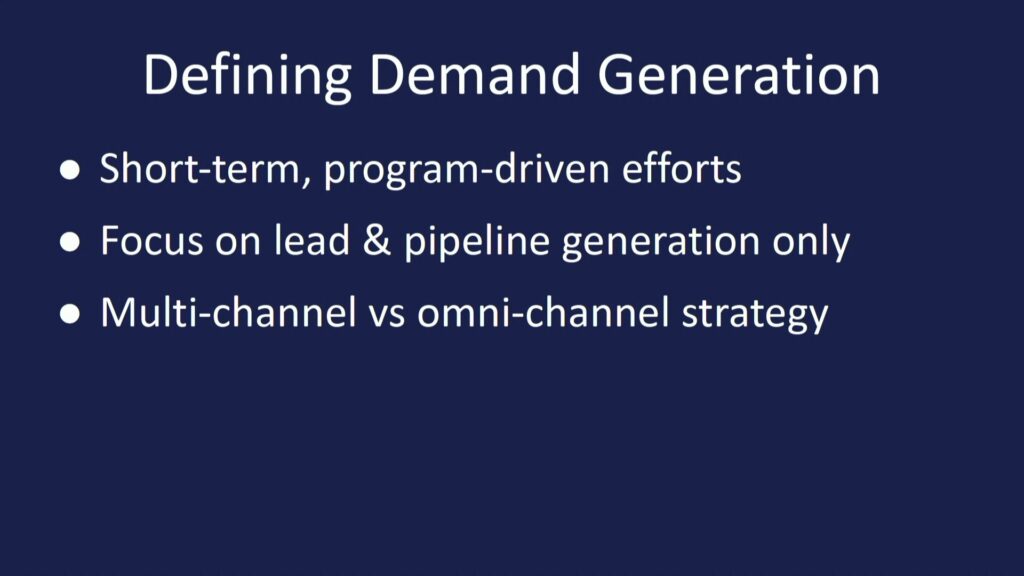
This is demand generation: It is a short-term, program-driven strategy focusing primarily on lead and pipeline generation. Okay?
Now I know Lee [Odden from TopRank Media], just before me, was talking about multichannel and omnichannel.
I have a different definition of multichannel and omnichannel.
My definition is: multichannel is using all the different channels that are available to you, but telling different stories across those channels.
Seeing, and trying to figure out, what does our audience resonate with? What are we looking for?
You really don’t know what’s working.
My analogy to you is like throwing spaghetti on the wall to see what sticks. And then you really don’t know what happened.
Why did it stick?
That’s what demand generation is.
I’ll give you another example.
Think of your webinar programs that you’ve run. What are your metrics for that webinar program? Is it open rate? Is it registrations? Is it how many people viewed you on demand? How many people actually joined you live?
That’s pretty much it.
There’s not much more to it, except for those kinds of numbers.
Your email programs: it’s about open rate, click rate, maybe how many downloads you got from that offer. But it doesn’t go beyond that.
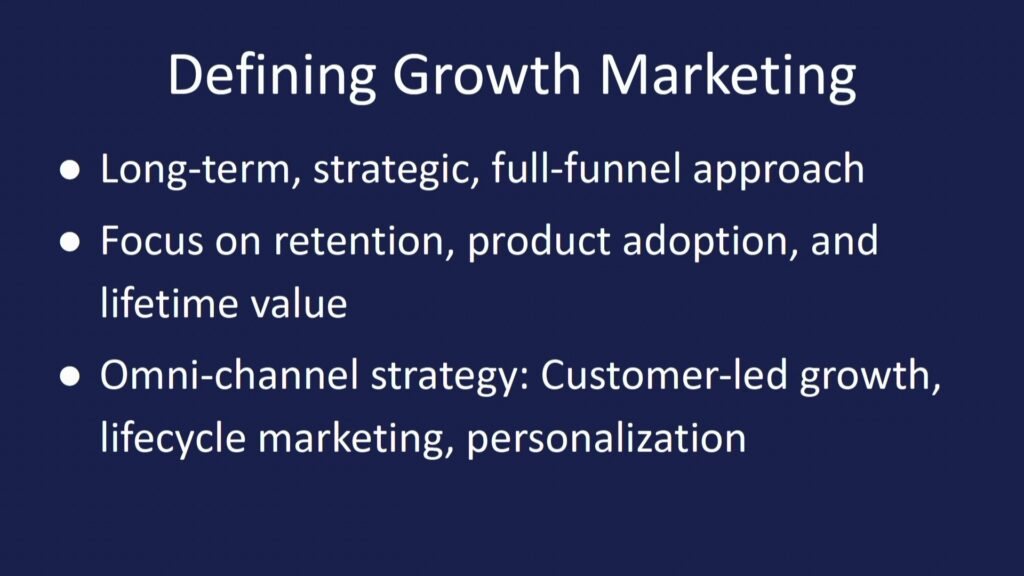
Defining growth marketing, it takes it a little bit further: it is a long-term, full-funnel strategy across the full buyer’s journey.
It focuses primarily on retention, product adoption, and customer lifetime value.
And I’m going to stop there because customer lifetime value—you’re going to hear me saying this a lot throughout my presentation—customer lifetime value is your key to success for growth marketing.
It is truly customer lifetime value.
And I’ll go into more detail on that.
And then I say it’s an omnichannel strategy. And what does that mean? That means you are still using the multiple channels that you have available to you.
However, you’re telling the same story across those channels and you are using different mediums to tell that story.
So it’s very different from what you’re trying to do with demand gen. Okay?
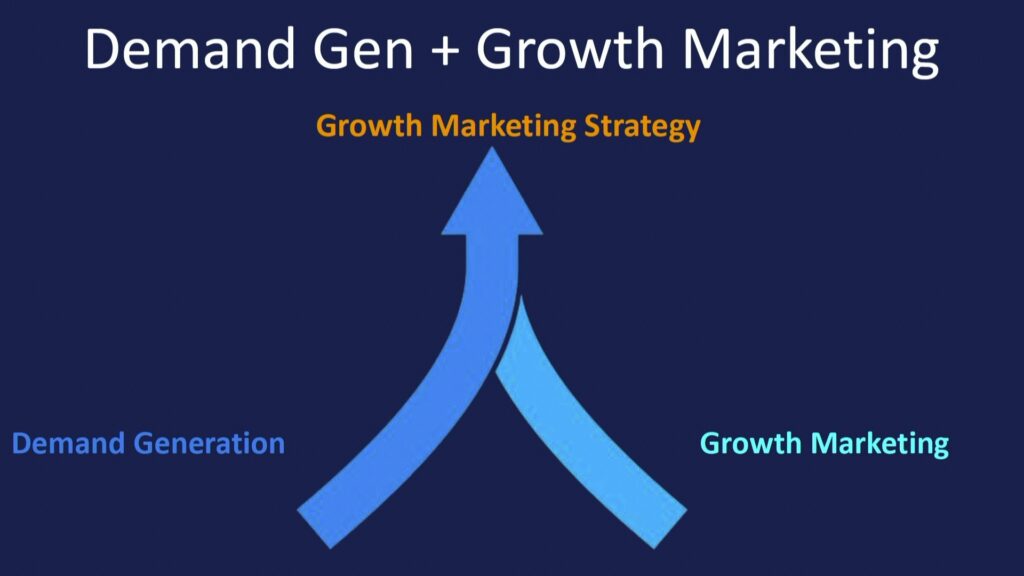
Another way to look at this… On the left-hand side, you’ve got a solid arrow up. That is your demand generation. I always say you need to have a solid demand gen engine before you can have a growth marketing strategy.
You then build your growth marketing strategy alongside it, in order to actually have a full-on successful growth marketing.
So you can have demand gen without growth, but you cannot have a growth marketing strategy without demand. Okay?
Now you guys are like, “why does this matter? It’s just semantics. It’s just saying one over the other.”
And I disagree.
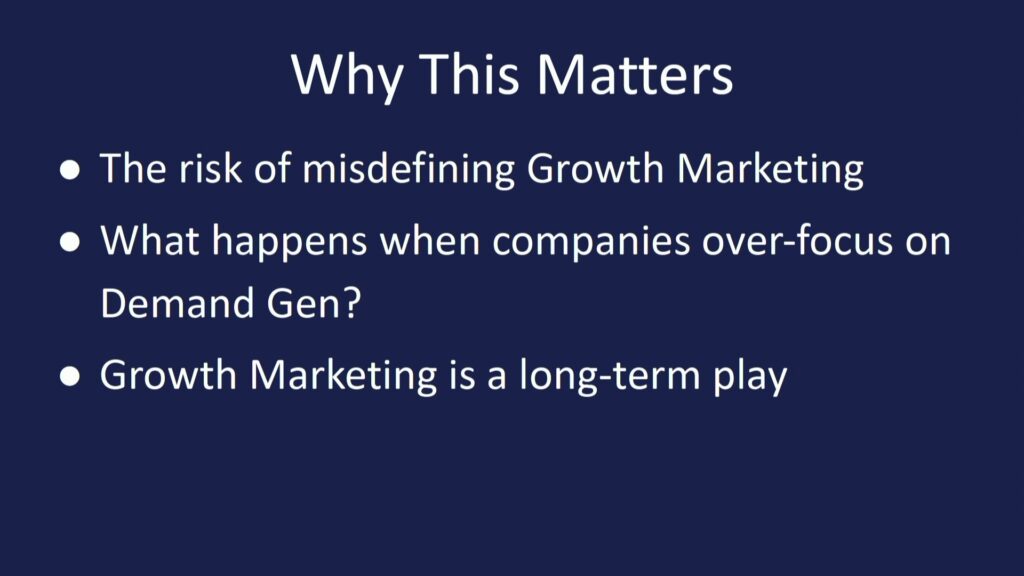
Because it is about the focus, the mindset, and the success metrics.
All of those are different when you’re talking about demand or growth.
It’s about the communication and expectations that you are delivering to your higher ups.
What you deliver is different.
You have to remember that growth marketing is a long-term strategy.
It’s going to take time to build success when you’re doing growth marketing.
It doesn’t take that much time when you’re doing demand gen, which is why a lot of times you have your teams just kind of… “Let’s just do demand. Forget growth. We don’t have time for growth. Let’s just do demand.”
But that’s not going to help the business at all.
And again, growth is about full funnel, product adoption, customer retention, and customer lifetime value. That’s where this comes in.
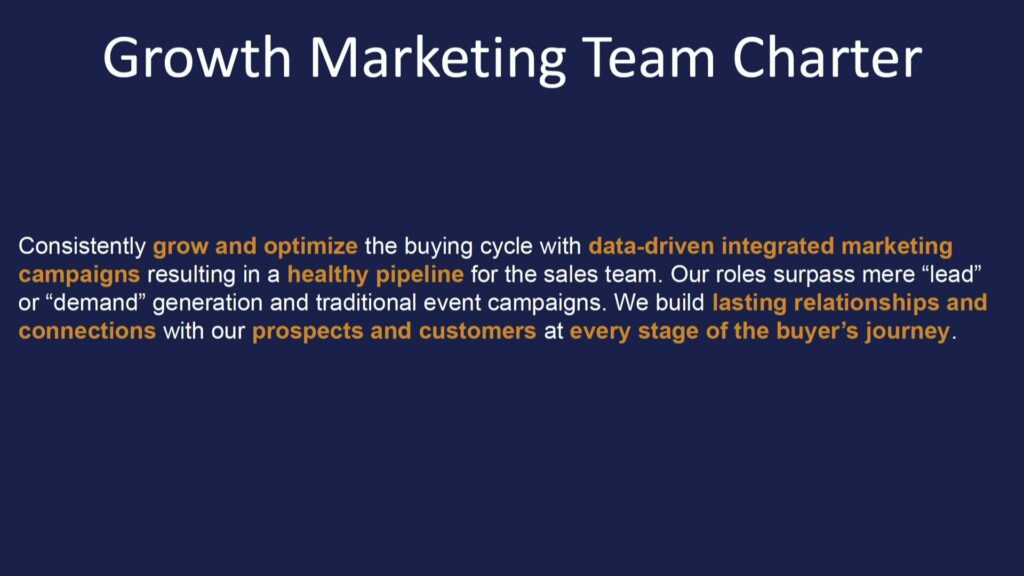
In my last job, it was really funny because I was asked, “Hey, can you put a definition again? What is your charter? What does your team do? You say you’re growth marketing. We have no idea what that means.”
That was an eye-opener for me: my own management team hired me on as a “growth marketing leader” …and had no idea what my team does and what I did!
So I put this together and I’ll read this. It really truly defines what I see growth marketing as being.
“We consistently grow and optimize the buying cycle with data-driven integrated marketing campaigns resulting in a healthy pipeline. Our roles surpass mere lead and demand and traditional event campaigns. We build lasting relationships and connections with our prospects and customers at every stage of the buyer’s journey.”
And then I went a little bit further. All about definitions, right?
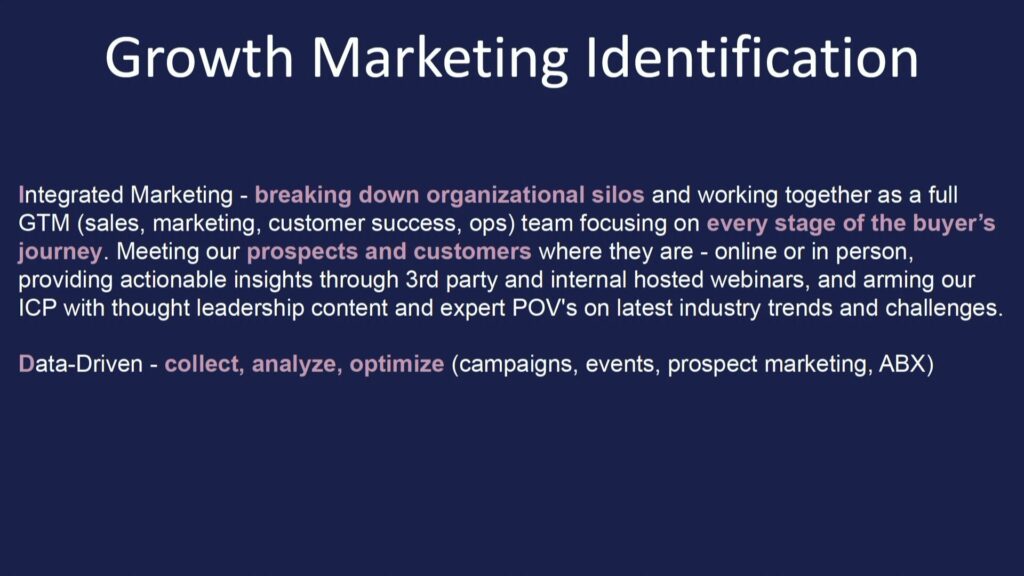
What is “integrated marketing?”
It breaks down the organizational silos and we work together as a full go-to-market team. Sales, Marketing, Customer Success, Ops… you name it. And you focus on every stage.
Very similar to what Lee [Odden] was saying…
It doesn’t just stop at the revenue.
It continues on to customer success and retaining those customers.
And we meet our prospects and our customers where they are.
We have to go to them.
They will not come to us.
Published March 31, 2026
B2B Forum is packed with marketing insights, strategies, and tactics taken from the real world experience of over fifty industry experts, packaged into context you can actually put to use.
Join us in Boston for B2B Forum on November 2-4, 2026. Early buyers get B2B Forum tickets at their lowest rate, and discounted hotel rooms are available while they last.