
Do you hand over your leads to Sales right away, or do you look for buyer intent signals first?
And how can Marketing help Sales close more deals?
These are a few of the questions Stephanie Ristow addressed at B2B Forum 2025.
And the solutions aren’t as complicated as you might think.
Discover how Stephanie helps brands close more deals in this clip from B2B Forum, or read the transcript below.
And if you need more leads and closed-won deals, consider surrounding yourself with other successful B2B marketers at B2B Forum! With over 50 stage sessions from today’s B2B marketing experts, plus inspirational keynotes and get-things-done workshops, B2B Forum is the place where B2B marketers grow their careers. Join us in Boston, Nov 2-4, 2026. Tickets are limited and available now!
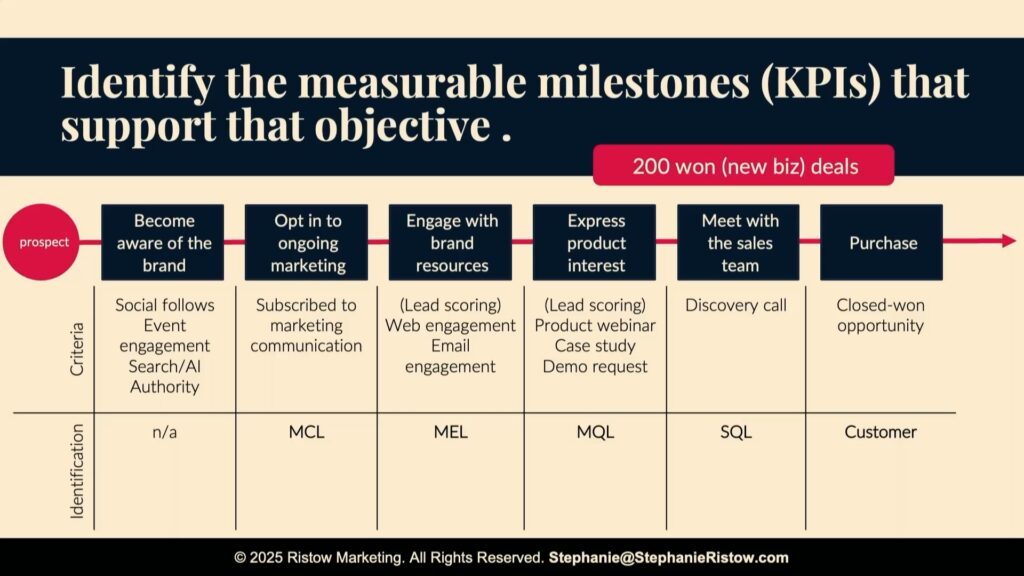
So up here, I’ve listed some example criteria and identification.
This becomes important because, even if you have life cycle stages set up in your system right now, what I would love for you guys to do… as you have your little worksheet out and want to start sketching some ideas, is ask yourself,
What are the real milestones that matter to your business?
Do you not actually care if somebody’s engaging? Is it really just getting them to opt in, getting them to qualify so we can go to Sales?
Or is it that Sales is reaching out to everybody regardless of whether they’re opted in or not? So you can truncate the whole front half of that and really it’s just about getting them to that meeting with Sales.
What are the milestones for your business that are most important?
And then—if your life cycle or your measurement tool that you have in place for how people are moving through and how you’re naming them as they’re moving through—if that doesn’t align to what realistically your business has become, what are the real measurements that you can use to bundle those up yourself so that you can create those baseline metrics?
And at the end we can talk about how you backpedal a little bit, if your life cycle stages are really far off and you need to edit that and have a big project to backfill those as they should be, that can be separate.
But what you want to do, even if it’s fairly analog, is identify the key performance indicators that show you which spot a prospect should be at within your life cycle and then get those baseline numbers.
So I’ll tell you, every time I talk about the life cycle of a customer, the number one question I’ll get from people—and I’m going to laugh really hard if somebody asks it anyway in here—is, “what should our conversion rates be from one thing to another? What is a good conversion rate from MCL to MEL?”
I don’t know.
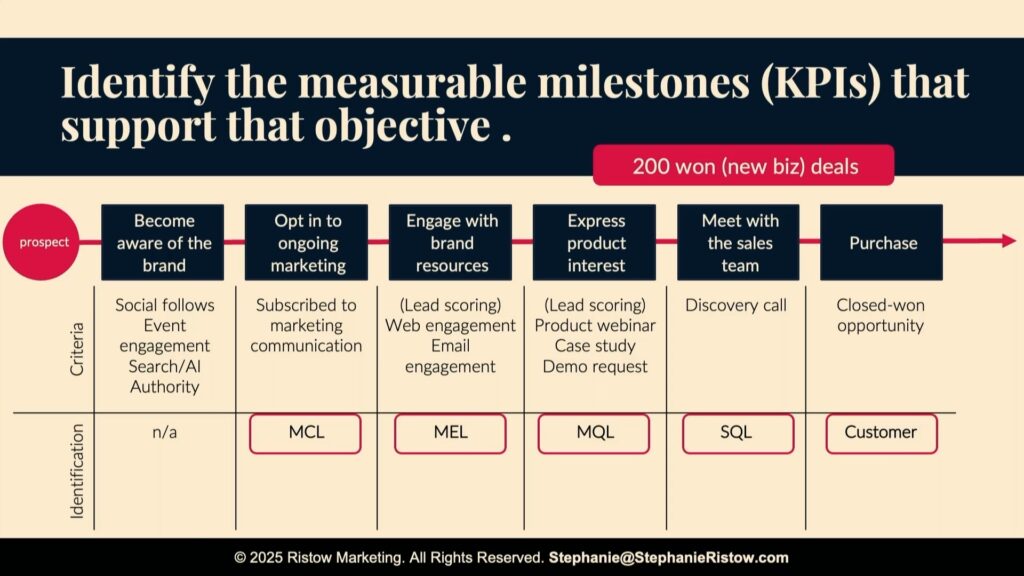
It’s different for every business because your criteria for what’s MCL versus MEL is different in every business.
But what you will know is that if one year it was 50% and the next year it was 10%, something went sideways, something significant changed.
So those baseline metrics are important. Oh, I circled them for you. Those are the life cycle stages that I have in mind for us here in this example.
Now we’re going to review our past metrics to identify our conversion benchmarks. So again, this is all around that primary goal, one of many that we had for the 200 won-new business deals. This is how we’re explaining to sales and leadership and whatnot how we’re going to get there.
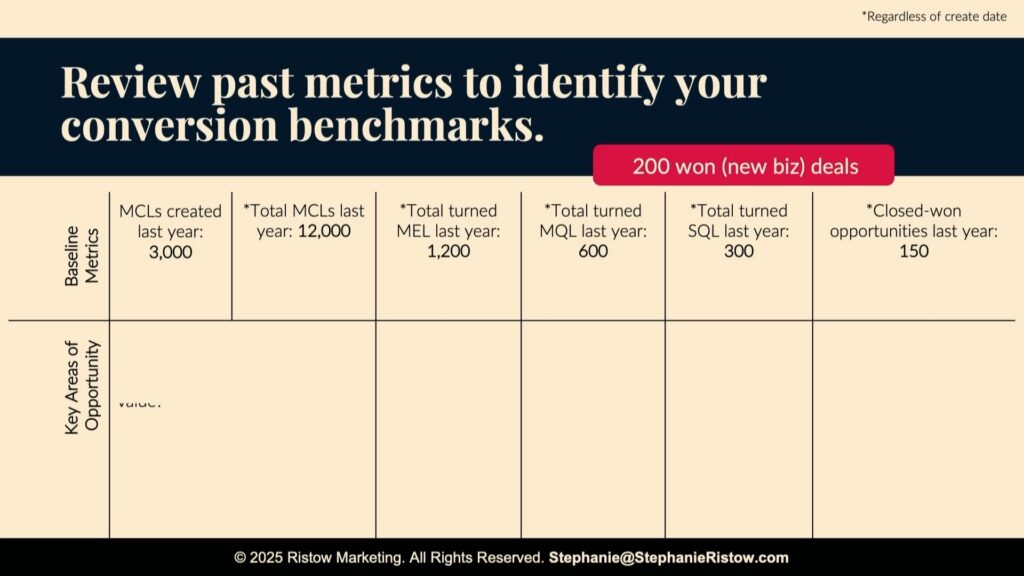
Now, looking at last year for this fake business that weirdly has very round numbers that make math easy, we had 150 closed-won opportunities. It’s not going to be enough this year. Our goal is higher. That came from 300 SQLs last year.
(You’ll see my little asterisks here, I’m saying regardless of create date. Because what a lot of the CRM systems do to make it easy to build these calculations in the funnel is they’ll only look at the leads created this year.
So of the leads you created this year, how many went to MEL? How many went to MQL? How many went to SQL?
But as a B2B marketer, we know that the life cycle can be a lot longer than a year. I don’t actually care if the SQL that landed here this year was originally created this year or last year.
What I care about is the fact that they moved to SQL this year. That’s the action that I was taking. So that’s what that asterisk means, just throwing that out there to make it clear because that can really screw up your numbers.)
We had 300 turn SQL last year out of 600 that turned MQL out of 1,200—you guys are seeing how lazy I am with math—that turned MEL.
And last year we had a total of 12,000 MCLs in our system. Now we created 3,000 MCLs, but in total we had 12,000.
That’s how we separate those numbers between what moved versus what was created.
So then with that in mind, this is where we get to start using our marketing brain, we can look at the key areas of opportunity that we know of, instinctively.
We can look at the numbers all day, but where our value comes in is we can say, “Damn, we sent 600 MQLs over to the sales team last year and only 300 of them converted to SQL…
“That feels problematic. There’s probably some things we can do to help the sales team to make sure that they’re seeing those MQLs, they have the right messaging in place to help qualify them…
“Is there a calendaring tool we can set up to make it easy for them to qualify them?”
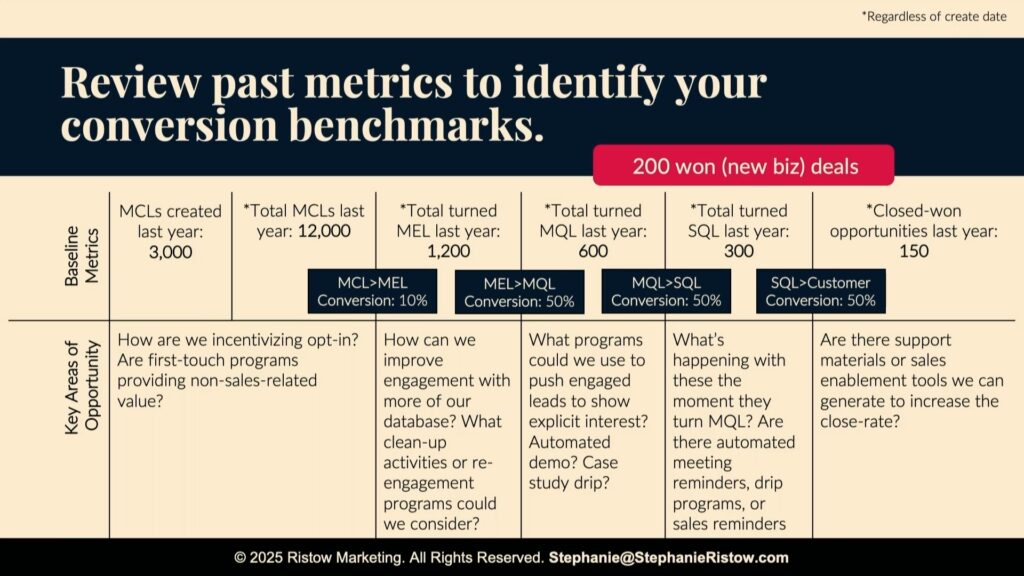
So I have examples of some of the opportunities that we might look to as we’re doing this. So key opportunities in the MCL range: Are we incentivizing opt-in? Is there something that we’re doing to make it valuable for people to opt into marketing from us? Are our first-touch programs providing non-sales related content?
Back at the beginning of this, I mentioned how some sales or company leaders are going to look at every marketing channel as a closing channel, right?
However, if you’re doing that, you’re not really getting people to opt in to receive continued communication from you unless they’re immediately ready to buy right that second.
So are you making sure that some of the opt-in materials that you’re providing to your audience are not sales focused, so that there’s an actual incentive to opt in with you?
And look, I did some math. MCL to MEL, we had a conversion rate of 10% last year.
So I want to know, how can we improve engagement with more of our database, right? So if most of the people in there are not opting into receiving ongoing marketing, is it because they’re not real? They’re bots? Is there a bunch we got to clean out of there so that it’s not impacting our numbers? What else can we do with sales enablement or events or things like that to get that opt-in so that we can push them further down the funnel?
I can see here that from engaged to—and by engaged in our scenario, I mean signs of life, they’ve done something noteworthy with us—over to MQL, we’re having a 50% conversion rate.
In some orgs, that might be pretty solid. Half the people that are engaging with us are saying that they have a need that there’s explicit interest in our product.
That’s great.
But if we want that to increase, what programs could we use to push engaged leads to show explicit interest? You’ve started engaging with our content, so now we’re going to send you case study content or a demo link for an on-demand webinar, or what are some of the things we can do to help push that forward faster?
And then of course, MQL to SQL is 50% here.
I’ll be honest with you guys, this is the biggest problem in most organizations.
And it’s so simple to solve in a lot of cases.
And part of why my business is doing really well is because people will come to me when they’re like, “I feel like marketing’s creating a lot of leads here. We’re doing a lot of stuff to push things forward. And sales is saying it’s all garbage and they’re not following up…” And there’s this weird conflict there.
Yes and yes. I will say both are right.
By and large, the solve here is so simple. It has to do more with there not being an SLA in place to say how fast sales needs to be following up when a lead goes through, the notification engine going over the sales team and the sales enablement platform in place to immediately start engaging with those that are MQLs.
So this is your biggest operational opportunity to improve things, to make sure that when that lead is hot, the Sales team is immediately following up, whether it’s really them or not, and we’re making sure that that’s happening.
As I said, here are some of the key opportunities. What’s happening with these the moment they turn MQL?
Sometimes it’s as simple as setting a weekly marketing and sales meeting on the calendar to be like, “Okay, here were the 12 hot leads that came out. What do you do with them? How can we help you?”
And then finally, SQL to Customer. This is where a lot of us are like, “This is out of my hands at this point. I can get it to SQL, but there’s not much else I can do.”
However, if that conversion rate’s really low, that’s going to impact our ability to market next year.
If we don’t sell enough, if we don’t close enough based on what we’re doing, we’re not going to continue to get the budget we need to continue doing that work, so it matters. So are there support materials or sales enablement tools that we can get into place to make sure that that close rate is actually happening?
The big takeaway here that I want you to look at is really making sure that we’re creating mini-plans around these conversion spots along the pipeline that we’re creating.
Published March 13, 2026
B2B Forum is packed with marketing insights, strategies, and tactics taken from the real world experience of over fifty industry experts, packaged into context you can actually put to use.
Join us in Boston for B2B Forum on November 2-4, 2026. Early buyers get B2B Forum tickets at their lowest rate, and discounted hotel rooms are available while they last.